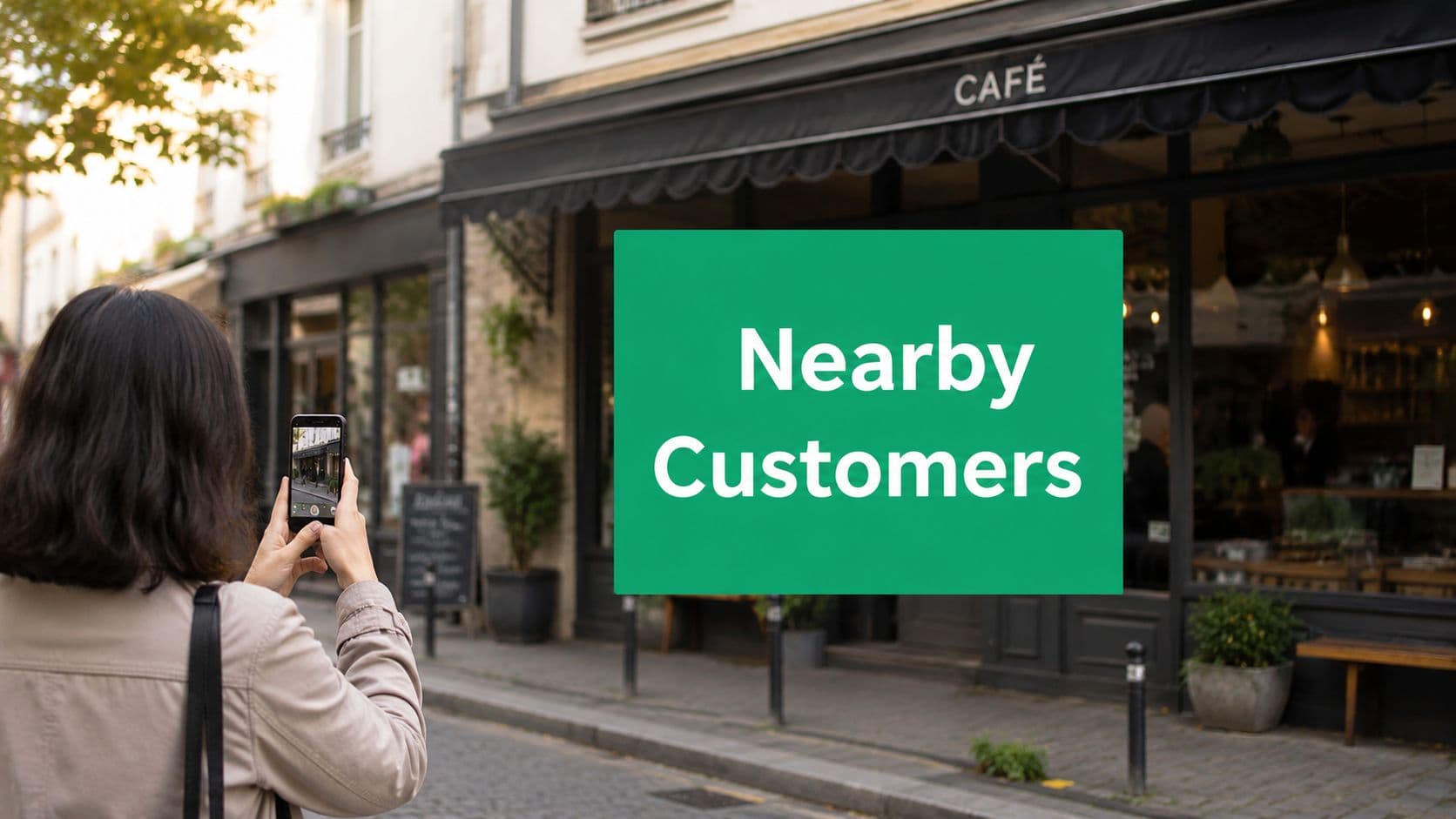
Why Instagram Is Your Best Local Marketing Tool
Many small business owners underestimate Instagram because they judge it by vanity metrics. Likes look low. Follower growth feels slow. A post that took an hour gets ignored. That creates the false idea that Instagram does not work locally.
It does. It just works differently.
Instagram already has the audience local businesses want. Instagram hosts over 350 million business accounts globally as of 2026, and nearly 80% of users follow a business account, according to Outfame's Instagram business statistics. That matters because you are not trying to teach people to use the platform for commerce. They already do.

Local attention is already there
For a local business, the goal is not to go viral. The goal is to show up often enough, clearly enough, and locally enough that nearby customers think of you when they are ready to buy. Instagram is built for that kind of repeated exposure.
If you run a café, salon, bookstore, gym, repair shop, clinic, or service business, people usually need a few simple things before acting:
Proof you're real. Photos of the space, staff, work, or results.
Proof you're nearby. Your city, neighborhood, map references, and location tags.
Proof you're active. Fresh posts, current Stories, recent replies, and visible customer interaction.
Proof it's easy. Clear directions, booking links, product tags, or DM prompts.
That is why Instagram works so well for local demand. It combines discovery, trust, and response in one place.
Practical rule: Do not ask whether Instagram can work for a local business. Ask whether your account makes it easy for a nearby customer to move from curiosity to visit.
It's stronger when organic and paid work together
Organic content builds familiarity. Paid distribution helps your best posts reach more nearby people. If you want a grounded walkthrough of optimizing Instagram ads for local markets, that resource is useful because it stays focused on local targeting instead of broad brand campaigns.
For the organic side, this broader guide to Instagram marketing for small business is also worth reviewing, especially if your account has been active for a while but still feels disconnected from real customer action.
The key point is simple. Instagram for local business works best when you stop treating it like a social feed and start treating it like a storefront with traffic signals.
Optimize Your Profile to Be a Local Magnet
A local customer should understand three things within seconds of landing on your profile: what you do, where you are, and what they should do next. If any of those are unclear, you lose momentum fast.
According to Boostigo's guide to Instagram for local businesses, the starting point is simple: switch to a Business account, use your 150-character bio to include your city and service, and build 3 to 5 Story Highlights around items like Menu/Services, Find Us, Reviews, and Events.
Build the bio for search and action
Most local bios waste space on slogans. Slogans rarely help discovery. A better bio reads like a mini listing.
Use this structure:
Name field: Include your business name and primary service. This improves your visibility in Instagram's search results, especially for local searches.
Bio line: Mention your city or neighborhood so visitors immediately know where you're located and whether your business is relevant to them.
Offer line: Clearly explain what you sell or the problem you solve. This helps people quickly decide if your account is right for them.
CTA line: Include a clear call to action, such as Book, Visit, Call, DM, or Order. This removes ambiguity and tells visitors exactly what to do next.
Link: Direct visitors to your booking page, menu, online store, or another key landing page, giving them one clear next step after viewing your profile.
A good local bio is specific. “Modern haircuts and color in Leeds. Walk-ins and bookings.” works harder than “Helping you feel confident.”
Set up the profile like a front desk
A strong profile should answer the most common local questions before someone asks.
Use Highlights to do the work your staff repeats all day:
Find Us: Add your storefront, parking notes, nearby landmarks, and a simple route clip.
Reviews: Save customer feedback, before-and-afters, reposted Stories, and short reaction videos.
Services or Menu: Show what is available, what is popular, and what first-time buyers usually choose.
Events: Keep seasonal offers, workshops, pop-ups, or special dates in one place.
FAQ: Cover opening hours, booking rules, lead times, and what customers should expect.
A local profile should reduce hesitation. If someone still needs to DM basic questions, your profile is not carrying enough of the sales load.
Make directions and contact impossible to miss
For brick-and-mortar businesses, one of the most useful profile outcomes is the move from profile view to store visit. That is why location and action buttons matter more than aesthetic polish.
A few profile mistakes show up constantly in local accounts:
No city in the bio. People should not need to infer your location.
No visual proof of the place. Customers want to know what they will walk into.
No path to action. If there is no clear link, phone option, or DM prompt, attention leaks away.
Highlights that only look pretty. Decorative covers are fine. Useful content matters more.
If your profile looks generic, fix that before spending more time on posting. A weak profile turns good content into wasted traffic.
Develop a Content Strategy That Attracts Locals
Content for a local business should do four jobs at once. Show the work. Build trust. Answer objections. Give people a reason to visit soon.
The cleanest framework here comes from The Stacc's local Instagram guide. It recommends a content mix of 40% showcasing work and behind-the-scenes, 25% educational tips, 20% social proof, and 15% promotions. It also recommends pairing posts with geo-tagging and 5 to 10 specific hashtags.

Use a repeatable local content mix
Take a neighborhood café as an example.
Showcasing work and behind the scenes is the biggest slice for a reason. People buy from places that feel active and human. That can include opening prep, the pastry tray coming out fresh, a barista dialing in espresso, or your team setting up for the morning rush.
Educational posts help customers make choices. A café might explain the difference between two roast styles, how house-made syrups are used, or which drink suits someone who does not like strong coffee. A florist could explain which stems last longest. A gym could show common machine mistakes.
Later in the week, switch gears.
Social proof includes reposted customer Stories, a quick video reaction, a review screenshot, or a photo of a repeat customer with permission. Promotional posts should stay limited. They work better when the rest of your feed has already built trust.
Match format to intent
Instagram users do not consume every format the same way. Some formats are better for discovery, some for consideration, and some for conversion.
Sprout Social's Instagram stats roundup notes that videos produce 38% more engagement than photos, and that Reels take up a large share of user attention on the app. For local businesses, that means video is often the fastest way to show atmosphere, movement, and personality.
A practical breakdown looks like this:
Reels for discovery: Walkthroughs, transformations, quick staff intros, process clips.
Carousels for saves: menu breakdowns, service explanations, before-and-afters, local guides.
Stories for daily action: polls, stock updates, same-day availability, weather-based offers, behind-the-counter moments.
If you want a deeper explanation of how short-form video gets distributed, this piece on Direct AI on Instagram Reels growth is useful because it focuses on how Reels gain traction without turning the advice into generic “post more video” fluff.
Here is a simple weekly planning model for a local business:
Behind-the-scenes content: Share authentic moments such as your morning setup, preparation process, or team at work. This helps people see the human side of your business and builds trust.
Educational content: Publish tips, answers to frequently asked questions, product comparisons, or service advice that help your audience solve problems and make informed decisions.
Social proof: Showcase customer reviews, reposted customer Stories, testimonials, or before-and-after results to demonstrate credibility and build confidence in your products or services.
Promotional content: Highlight limited-time offers, event invitations, new product launches, or seasonal promotions to encourage timely action and drive conversions.Geo-tag every post and stop using lazy hashtags
Location signals matter more than many businesses realize. If you serve a real-world area, every post should tell Instagram and the viewer where that post belongs.
Use:
A clear geotag tied to your business or neighborhood
A tight hashtag mix based on local + industry + niche
Captions that mention place names naturally
Visual references that make the location obvious
A bakery in Bristol should not rely on broad tags alone. It should use the neighborhood, the city, the product category, and the specialty. Relevance beats volume.
One more practical note. Keep a working content bank on your phone. Good local content often comes from ordinary moments you would otherwise forget to document.
For extra planning help, a content strategy template for Instagram can make this much easier to run consistently.
Turn Local Engagement Into Real Foot Traffic
Most businesses fall short. They post, wait, and hope attention turns into visits.
It usually does not. Not on its own.
The missing piece is the conversion bridge. That is the set of actions that moves someone from seeing your account to walking in, sending a DM, asking for availability, or tapping directions. Without that bridge, engagement stays digital.
Why hyper-local engagement beats broad visibility
One of the strongest local takeaways comes from Wordtracker's local Instagram marketing article. It points out that businesses engaging with 20 local accounts daily saw 3x more profile visits from nearby users than those using 30+ broad hashtags.
That lines up with what works in practice. Broad hashtag reach can bring random attention. Local engagement brings qualified attention.

Run a daily local engagement loop
This does not need to be complicated. It needs to be consistent.
A good daily workflow looks like this:
Check nearby geotags. Look at posts and Stories from your neighborhood, nearby streets, venues, and landmarks.
Engage with non-competing local businesses. Comment on the bakery near your salon, the gym near your clinic, the bookstore near your café.
Reply like a person, not a brand bot. Short, relevant comments beat generic praise every time.
Watch for intent signals. Questions about stock, parking, timing, waitlists, or recommendations often signal visit intent.
Move warm interest into DMs. If someone asks something practical, answer publicly when helpful, then continue in DMs if needed.
Most local businesses do not need more reach first. They need more conversations with people who already live, work, or spend time nearby.
Use Stories and DMs as the bridge
Stories are where local buying decisions often become immediate. They create urgency without the weight of a feed post.
Use Stories for things like:
Today-only updates such as fresh stock, openings, cancellations, or weather-driven offers
Quick social proof like reposted customer visits
Micro-CTAs such as “DM to reserve,” “We've got space this afternoon,” or “Tap directions”
DMs are where hesitation gets resolved. That is why response style matters. Keep replies fast, clear, and local.
Bad DM: “Thanks for reaching out. Please see our website.”
Better DM: “Yes, we've got availability this afternoon. We're two minutes from the station. If you want, I can hold a spot for you.”
Give people a reason to come now
A lot of local content is informative but passive. It looks fine, but it does not create motion.
Use calls to action that fit local behavior:
Weak CTA: Check our latest post.
Stronger local CTA: Stop by before lunch.
Weak CTA: Link in bio.
Stronger local CTA: Tap Directions in our profile.
Weak CTA: Let us know what you think.
Stronger local CTA: DM us, and we'll confirm today's availability.
Weak CTA: Shop now.
Stronger local CTA: Pick up in-store today.
Only some posts need a direct CTA. But when you do ask for action, tie it to an in-person benefit. That is what turns Instagram for local business into a traffic channel instead of just a branding channel.
Use Simple Ads and Track Your Local Impact
A lot of small businesses avoid ads because they assume paid social means campaign complexity, creative testing, and wasted spend. For local Instagram, it does not have to.
Simple ads work when you boost posts that already proved they can hold attention. Start with content that shows the space, the experience, or the result. For many local businesses, that means a Reel, a customer reaction clip, or a post that generated strong comments and DMs organically.
Keep the ad setup narrow
Sprout Social's Instagram stats report that 48% of marketers cite Instagram as delivering the highest ROI of any social platform in 2026, and that video formats produce 38% more engagement than photos. That does not mean every boosted post will perform well. It means Instagram deserves a serious look if you are targeting nearby buyers and using video creatively.
For local businesses, the simplest paid setup is often the best:
Choose one proven post. Do not boost something just because it looks polished.
Use local radius targeting. Keep the audience geographically relevant.
Match the goal to the post. A directions-oriented post and a bookings-oriented post should not use the same message.
Send traffic to the easiest next action. Directions, DMs, booking page, or menu.
If you want a better handle on audience setup, this guide to Instagram targeting options gives a useful overview of how to think about local targeting choices without making the process feel bigger than it is.
Watch intent metrics, not vanity metrics
Follower count can mislead local businesses. Plenty of accounts have decent follower numbers and very little store impact. What matters is whether the account creates signs of intent.
According to Boostigo's local business guide, the best brick-and-mortar conversion metric in Instagram Insights is Get Directions Taps, with Website Taps and DM Inquiries as strong secondary signals.
That is the shift local businesses need to make. Stop asking, “Did this post get enough likes?” Start asking:
Did people tap for directions?
Did they ask whether something was available?
Did they click to book?
Did staff notice customers mentioning the post or Story?
What to measure: If a post gets modest engagement but drives direction taps or direct questions, keep it. Local revenue usually shows up in intent signals before it shows up in follower growth.
Boost what already has local proof
When a post does well with locals organically, that is often your best candidate for paid support. Common winners include short walkthrough videos, team intros, customer testimonial clips, popular menu items, and “what to expect when you visit” content.
What usually underperforms is generic branding. Mood shots with no offer, no local cue, and no next step might look good in the grid, but they rarely move someone toward action.
Your 90-Day Plan for Local Instagram Growth
The biggest mistake is trying to overhaul everything in one week. That usually leads to a burst of effort, a pile of half-finished ideas, and a dead account by month two.
A better approach is to build in phases. Tighten the profile first. Then get consistent. Then add local engagement. Then test paid support and refine based on what generates movement.
Days 1 to 30
Start with the parts that remove friction.
Fix the profile. Add your city, service, and strongest next step. Build Highlights that answer real customer questions.
Post consistently. Use the content mix discussed earlier. Do not chase novelty. Focus on useful repetition.
Geo-tag everything. Make every post locally legible.
Begin daily engagement. Spend a short block of time engaging with nearby people and businesses.

At this stage, do not worry about making the account look perfect. Make it clear, active, and easy to act on.
Days 31 to 60
At this stage, the account starts to feel less like a noticeboard and more like a customer acquisition system.
Test more of what gets people talking. Use Stories more often for availability, local updates, and short prompts that invite replies. Save the best answers and recurring questions in Highlights.
Add collaboration where it makes sense.
Local partnerships: Partner with nearby businesses by exchanging shoutouts, creating collaborative posts, or running joint campaigns to reach each other's local audiences.
Social proof: Regularly repost customer Stories, reviews, testimonials, and feedback to build trust and show real experiences with your business.
Reels: Turn frequently asked questions into short, informative Reels that educate potential customers while increasing your reach.
DMs: Respond to direct messages promptly and guide interested people toward the next step, whether that's visiting your location, booking an appointment, or making a purchase.
If organic reach is still a weak point, this guide on how to increase organic Instagram reach is a useful companion because it emphasizes sustainable visibility rather than gimmicks.
Days 61 to 90
By now you should have enough signal to notice patterns. Certain topics get saved. Certain Stories trigger replies. Certain posts prompt practical questions.
Double down on those.
Refine your calls to action. Promote the posts that already attract nearby intent. If something looks popular online but never produces questions, direction taps, or store mentions, treat it as support content, not core growth content.
A simple review checklist helps here:
Which posts led to DMs or questions
Which Stories drove action quickly
Which content types locals shared or saved
Which boosted posts created useful intent
Which profile elements still create confusion
Instagram for local business gets easier once you stop looking for one winning post and start building one reliable system.
If you want help growing an Instagram presence that attracts real followers and stronger engagement without fake activity, Gainsty is built for that. It's a practical fit for businesses that want more organic momentum on Instagram while keeping growth focused on authenticity and long-term account health.
.png&w=1920&q=75&dpl=dpl_2si4hWs7xtpQVmrY6d8xhJ1wLJZL)




.png&w=750&q=75&dpl=dpl_2si4hWs7xtpQVmrY6d8xhJ1wLJZL)