Why Defining Your Instagram Marketing Target Audience Matters
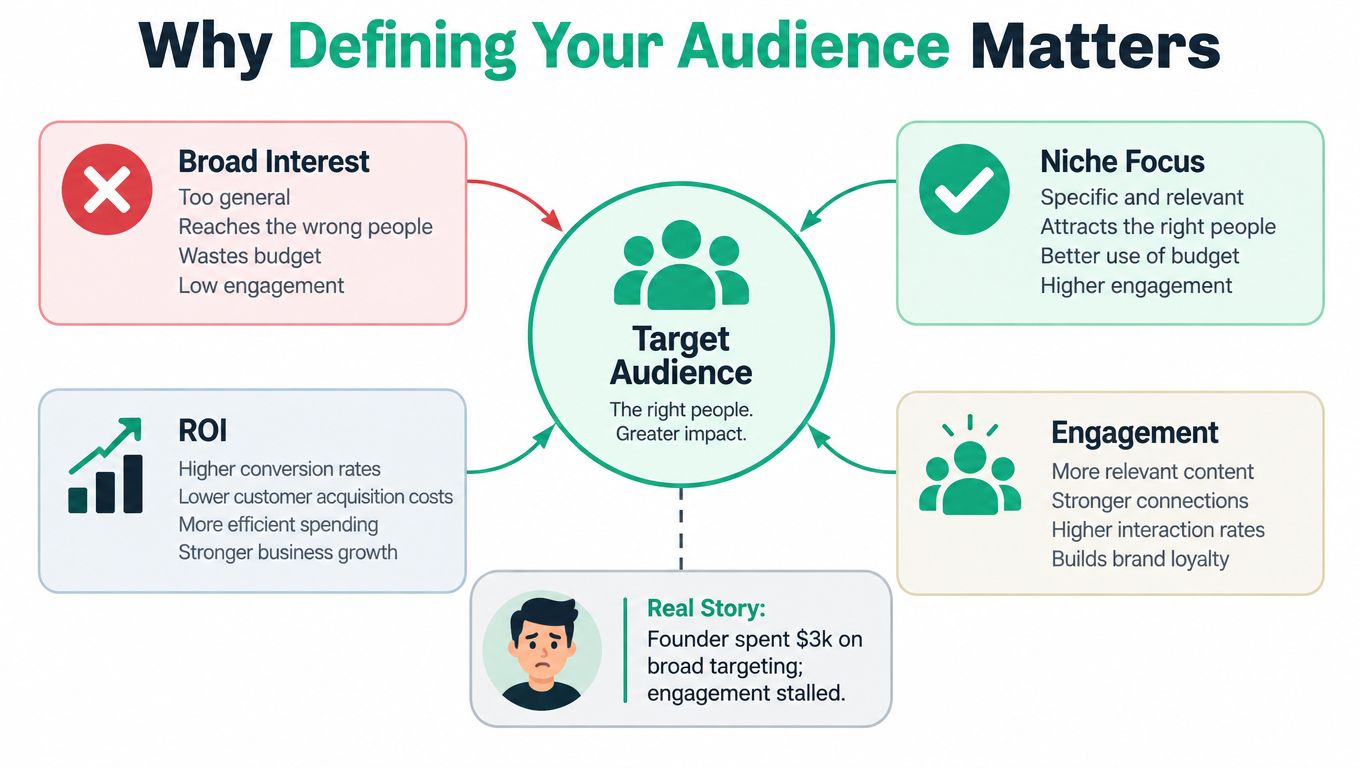
A follower who has no meaningful connection to your offer can inflate your audience while weakening your marketing. When people don't save, share, reply, visit your profile, or buy, your content receives less useful feedback. Paid campaigns can also spend against people who match an interest label but lack the problem, urgency, or buying context your business addresses.
Practical rule: Define the audience by the problem they're trying to solve, not only by the traits they happen to share.
Audience definition affects three connected outcomes:
Budget efficiency: Precise hypotheses give you cleaner ad tests and make it easier to see which audience groups deserve more spend.
Engagement quality: Content written for a recognizable need is more likely to produce meaningful comments, saves, shares, and direct messages.
Distribution signals: When the right people respond consistently, your account gets stronger evidence about who should see future content.
Four layers turn a guess into a strategy
Platform-wide demographics provide the starting boundaries. Age, location, and gender can tell you whether your intended market is present, but they can't explain why people engage or purchase.
Niche-level signal mining adds evidence from competitor content, hashtags, comments, creator communities, and recurring questions. It is at this point that broad categories crystallize into specific problems, preferences, and language patterns.
First-party data comes from people already interacting with your business. Instagram Insights, website analytics, customer records, email subscribers, DMs, and purchase history reveal which assumptions match real behavior.
Persona translation turns the findings into content and targeting decisions. A persona should tell you what to publish, who to exclude, what offer to test, and which Meta Ads Manager fields are relevant.
Many teams stop after the first layer because demographics are easy to report. The harder work involves reading comments, comparing engaged followers with passive followers, and connecting Instagram activity to commercial intent. Skipping those deeper layers leaves you with a large audience description but no reliable explanation of who deserves your next creative test.
The Global Instagram Audience in 2026
A founder launching a campaign for a 25-year-old customer may assume the audience is obvious. The same age can describe a fitness viewer, a personal trainer, or someone recovering from an injury. Their needs, language, and response to creative can differ sharply. Platform data gives you the outer boundary, not the finished target audience.
Instagram's worldwide users are concentrated among younger and working-age adults, with more than 62% of global users between 18 and 34, according to Outfame's Instagram audience summary. The largest global age group is 25 to 34. Men aged 25 to 34 account for 17.6% of the global advertising audience, based on the same source.
Gender figures sit close to balance, although datasets vary. One 2026 dataset reports 52.5% male and 46.5% female, while another reports 50.6% male and 49.4% female, as summarized by Buffer's Instagram statistics guide. Use this as a planning reference, not as a reason to target one gender automatically.
Location changes the audience substantially. India has 472.6 million users, the United States has 179.9 million, and Brazil has 147.0 million, according to the same Buffer reference. Together, these markets represent more than 36% of Instagram's global user base. An international campaign may need different creative, language, and posting schedules by market.
The largest global Instagram age group is 25 to 34, so this is often the best cohort to test first before comparing results with your own customer evidence. People aged 18 to 34 make up more than 62% of global users, which supports mobile-first, fast-scanning creative when the product fits that audience.
India is the largest country market, with 472.6 million users, so brands targeting that market should adapt language, cultural references, and posting windows. In the United States, adoption varies meaningfully by age: 80% of adults aged 18 to 29 use Instagram, compared with 62% of adults aged 30 to 49, 40% of adults aged 50 to 64, and 19% of adults aged 65 and older. That makes it useful to treat U.S. age groups as distinct segments rather than one blended audience.
U.S. adoption also differs by race and ethnicity. Instagram use reaches 62% among Hispanic adults, 58% among Asian adults, 54% among Black adults, and 45% among White adults. These differences are a reminder to examine community and cultural context alongside age.
For a fuller platform-demographic breakdown, read Gainsty's guide to Instagram audience demographics.
What the baseline does and doesn't tell you
The global profile supports an initial test of visually driven, mobile-first content for younger adults when the offer fits their needs. It also signals that international brands should plan regional variants instead of translating one global asset. Sprout Social's audience analysis identifies the 25–34 cohort as the largest global advertising segment, at about 33% of the worldwide ad audience.
Those figures do not identify the best customer for a specific offer. Use platform demographics to set the boundary, niche signals to refine the problem and language, and first-party evidence to decide which audience deserves budget.
Audience Research Methods You Can Run This Week
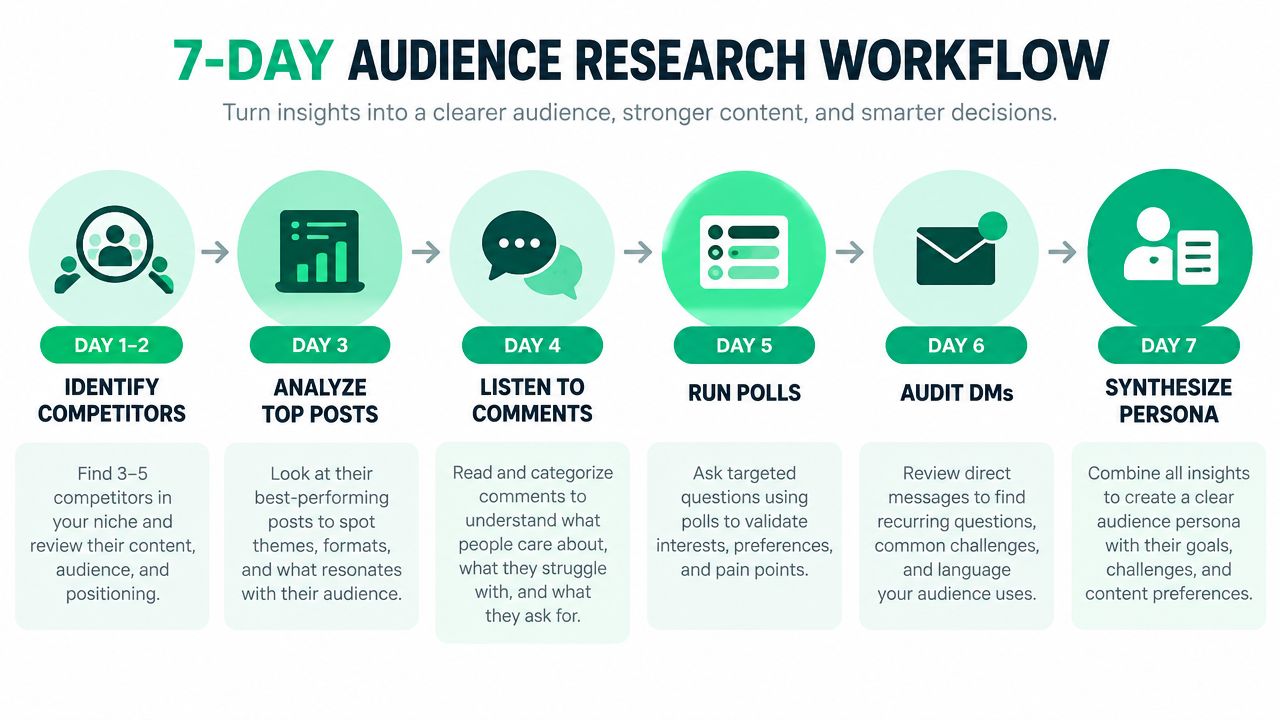
You don't need a large research budget to build an initial audience brief. You need a repeatable process that separates observation from assumption. Reserve one week, keep a shared spreadsheet, and record the post URL, topic, format, visible response, audience language, and your interpretation.
Start with the market, not the ad interface
Days 1 and 2, map the competitive neighborhood. List five direct competitors and ten adjacent accounts. Direct competitors sell a similar solution. Adjacent accounts may serve the same problem through education, community, complementary products, or creators. Save posts that attract visible conversation and note whether the response centers on questions, personal stories, product objections, or requests for recommendations.
Days 3 and 4, audit discovery language. Search three hashtag tiers: broad category terms, mid-tail niche terms, and micro-community terms. Don't judge a hashtag only by how popular it appears. Log the accounts and posts it surfaces, then identify which topics generate saves and shares relative to the account's visible audience.
For technical collection across public Instagram data, an Instagram scraper resource from Scrapfly can help you compare available approaches. Follow Instagram's terms, privacy requirements, and applicable laws, and don't treat scraped public activity as a substitute for consent-based customer data.
Add first-party evidence before writing the persona
Day 5, inspect Instagram Insights. Compare top locations, age bands, audience composition, active periods, reach sources, and the posts that attract non-followers. The point isn't to accept the dashboard as truth. Compare it with your intended customer and mark every meaningful mismatch.
Day 6, ask your audience directly. Use a five-question Story poll, question sticker, or DM survey. Ask what triggered their interest, what they've already tried, what nearly stopped them from buying, which content they save, and what outcome they want next. Keep questions concrete. “What do you struggle with?” often produces vague answers, while “What makes you delay this purchase?” usually exposes friction.
Day 7, write three hypotheses. Each hypothesis should include a group, a problem, a content angle, and a behavior you expect to observe. For example, “People returning to exercise after an injury may save low-impact progression guides and ask about safety in DMs.” A hypothesis is useful because you can prove or disprove it.
For a broader explanation of interpreting account-level data, review Gainsty's guide to Instagram audience insights.
Don't copy a competitor's audience word for word. Their offer, reputation, pricing, creative quality, and customer history differ from yours. Also don't trust a generic interest such as “fitness” or “beauty” without behavioral evidence. Use interests as test inputs, not proof of intent.
Turning Research into Segments and Personas
Research becomes useful when you group people by meaningful differences in needs and action, not merely by labels. A practical segmentation model uses five lenses.
Behavioral signals describe what people do. Look for saves, shares, replies, link clicks, repeat profile visits, product questions, and post formats that hold attention.
Psychographic signals reveal how people think. Comments may show whether an audience values speed, status, safety, affordability, sustainability, expertise, or community.
Lifecycle stage separates someone discovering a problem from someone comparing solutions or looking for reassurance after purchase. The same person can move between stages, so lifecycle is a working dimension rather than a permanent identity.
Platform context captures how people use Instagram. One segment may discover through Reels, another may rely on Stories, and another may start a conversation through DMs.
Commercial intent distinguishes curiosity from readiness. A person asking for a checklist has a different immediate need from someone asking about availability, delivery, consultation, or fit.
A useful audience segmentation framework from Gainsty can help you organize these differences without turning your persona document into a demographic census.
A worked fitness example
Suppose a fitness business notices recurring comments from people who want to return to training after an injury but feel uncertain about progression. A workable persona might be:
Persona name: Jordan, the cautious returner
Snapshot: Jordan is a busy professional who wants structured movement that fits around work and supports a safe return to exercise. Jordan doesn't need motivational slogans first. Jordan needs clear modifications, progression cues, and confidence that the program respects current limitations.
Three goals:
Rebuild consistency without aggravating the injury. - Understand which movements to start with and how to progress. - Find guidance that fits short, practical sessions.
Three frustrations:
Generic workouts assume full mobility. - Online advice contradicts itself. - The person feels embarrassed asking beginner questions.
Preferred formats: Demonstration Reels, saved carousels, short Stories answering safety questions, and DMs that clarify the next step.
Buying signal: Jordan asks how the program adapts to a specific limitation and what support comes with it.
Keep personas operational
A niche can produce multiple valid personas. A fitness account might also attract a competitive athlete seeking performance programming and a beginner who needs accountability. They may share an age range, but they need different hooks, examples, offers, and calls to action.
A persona earns its place when it changes a decision. If the description doesn't affect content, creative, landing-page language, or audience exclusions, it's decoration rather than strategy.
Matching Personas to Instagram Targeting Tools
The persona should now become a set of actions. Start with organic signals because they reveal what your existing audience responds to without requiring an ad budget. Instagram's follower and content insights can show which topics attract the people you want, while Reels trend signals can reveal formats, sounds, and presentation styles worth testing. Content preferences and interaction patterns also help you distinguish passive reach from active interest.
Use each layer for a different job
Use demographic context, such as audience age, gender, and location in Insights, to set an initial market boundary through location, age, and gender controls in Meta Ads Manager. Use psychographic motivation, including repeated language in comments, replies, and saves, to test messaging themes through relevant detailed targeting interests, while remembering that these interests do not guarantee intent.
Behavioral activity, such as profile visits, video engagement, DMs, and website actions, is best matched to custom audiences and engagement audiences so you can reach people who have already shown interest. Customer relationship data, including purchases, leads, and email records, maps to customer file custom audiences and is useful for re-engaging known prospects or customers. Expansion potential should come from a qualified seed group that has already responded well, then be scaled through lookalike or Advantage+ audience controls to find similar people.
Detailed targeting works best when you have a clear reason for each selected interest or behavior. If Jordan's research points toward injury recovery, mobility, and structured training, build creative around those needs and test relevant audience inputs. Don't stack every adjacent interest just because Ads Manager offers it.
Custom audiences are more valuable when your first-party data is clean. Website visitors, customer files, lead lists, and people who engaged with your Instagram account can support retargeting, exclusions, and controlled expansion. Make sure you have the necessary permission and follow Meta's policies before uploading or using customer information.
Broad versus narrow targeting
Narrow targeting helps when the problem is specialized, the offer is location-bound, or the creative depends on a distinct community vocabulary. It can hurt when the audience becomes too small, the signals overlap poorly, or the platform lacks enough room to find qualified people.
Broad targeting can outperform a tightly stacked audience when your creative clearly communicates the problem and your conversion data gives Meta useful feedback. Use exclusions to protect budget, such as removing existing customers from acquisition campaigns or excluding people who have already completed the desired action.
Treat Advantage+ audience controls as an expansion option, not a replacement for research. The system may find people beyond your initial suggestions, but you still need a defined customer, a clear offer, and a measurement plan to judge whether that expansion is valuable.
Metrics That Prove Your Audience Definition Is Working
Audience fit appears first in behavior, then in business outcomes. Don't rely on follower growth alone. A large reach number can hide weak relevance, while a smaller group may produce the comments, saves, inquiries, and purchases that sustain the account.
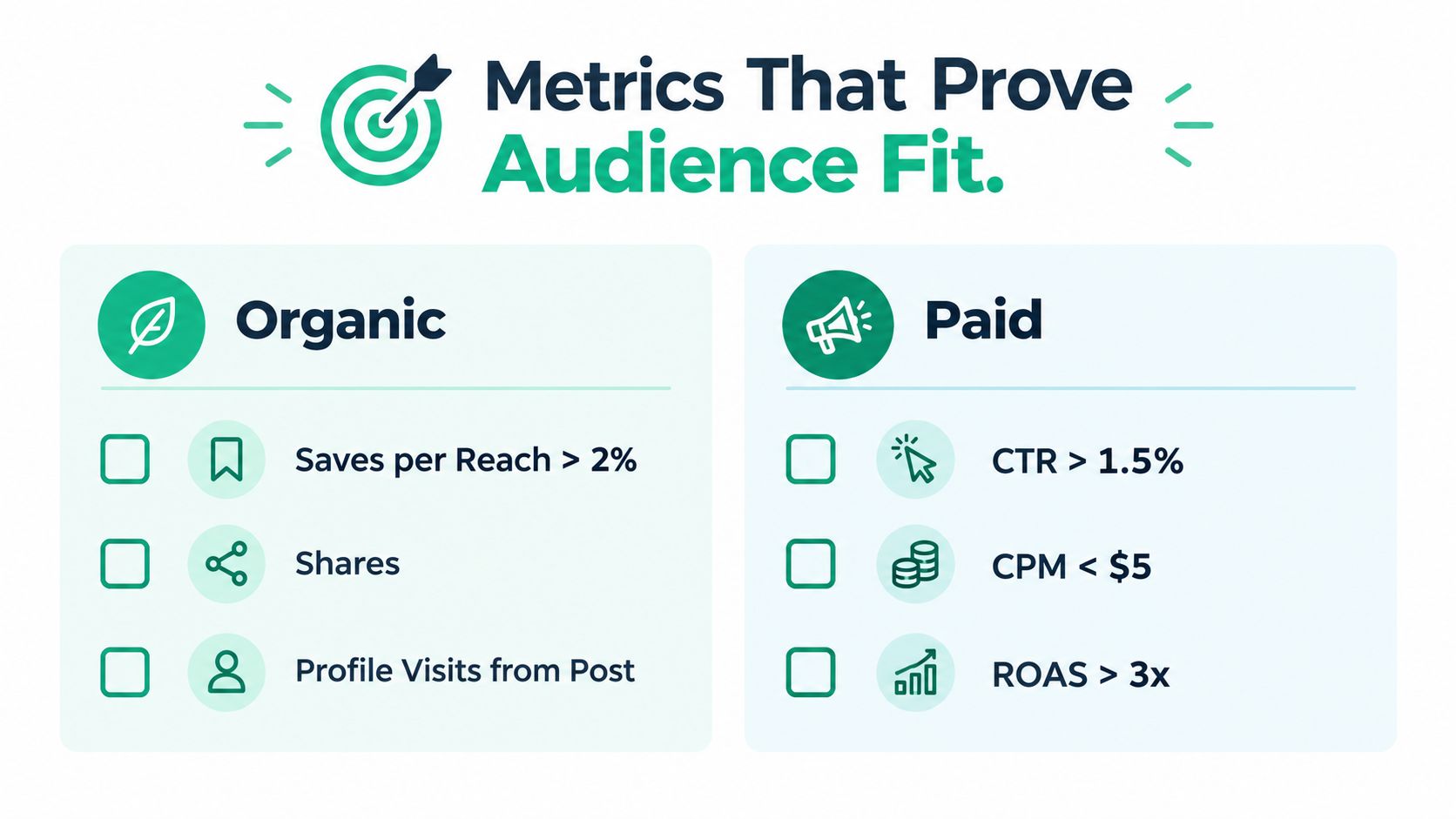
For organic content, monitor:
Saves per reach: Strong saves suggest the content solves a problem people expect to revisit.
Shares: Shares indicate that the topic feels useful or relevant enough to pass to another person.
Profile visits from non-followers: This shows whether discovery content creates curiosity about your account.
Follower-to-engagement ratio: Compare the size of your follower base with meaningful interactions, not only likes.
Comment sentiment: Read the language. Questions about fit, objections, and next steps are more strategically useful than empty approval.
Paid campaigns need a separate view:
CPM by segment: Compare the cost of reaching different audience groups, but don't choose the cheapest group automatically.
CTR: A weak click-through rate can indicate a mismatch between the hook, offer, and audience.
Reels ad hook rate: Check whether the opening earns attention before evaluating the rest of the funnel.
Performance decay by frequency: If results weaken as the same people see the ad repeatedly, refresh creative or adjust reach.
Cost per qualified action: Define the action that matters, such as a relevant lead, consultation request, or purchase.
Read signals across a 30 to 90 day window
Early saves, shares, profile visits, and qualified comments suggest that the message may be reaching a relevant group. If people watch but don't take a meaningful next step, test the promise, proof, call to action, or landing page before rebuilding the audience.
A creative mismatch often produces attention without useful action. A persona problem appears when several creative angles fail with the same group, the comments reveal a different need, or qualified people consistently reject the offer.
Use a simple decision rule: compare each segment's cost per engaged follower or qualified action with your own established benchmark. Expand a segment when the cost is acceptable, and the resulting engagement shows clear relevance. Cut or revise it when the cost stays high, and the interactions remain shallow.
Run a monthly audience review
Compare intended and actual audience: Check location, age, and audience composition against your brief.
Review top content: Identify the subjects and formats that generated meaningful actions.
Read qualitative feedback: Summarize recurring questions, objections, and phrases.
Separate discovery from conversion: Keep reach content and offer content in different analyses.
Update hypotheses: Change the evidence, not the entire persona after one weak post.
Choose one controlled test: Adjust one audience layer, creative angle, or offer at a time.
Applying the Framework to Influencers and Small Businesses
An emerging fitness creator with 12K followers and a regional skincare brand with two locations can collect the same research outputs and still need different strategies. The creator needs to understand community identity, content discovery, and collaboration overlap. The skincare brand needs to understand local demand, store access, and which customer groups can act on a nearby offer.
The creator's interpretation
The fitness creator might find that followers respond to practical recovery content, discover the account through niche hashtag clusters, and engage most with demonstration Reels. The primary persona could be the cautious returner described earlier, while a secondary persona might seek more demanding performance guidance.
That creator should use collaboration posts, adjacent accounts, recurring questions, and Reels trend signals to find audience overlap. The first content calendar can reserve slots for demonstrations, myth correction, follower questions, and creator collaborations. If the creator later works with an external partner, a structured growth system service for influencer marketing may help organize collaboration and audience development activities.
The local brand's interpretation
The skincare brand might find that customers differ by location, skin concern, shopping convenience, and trust signals. Its primary persona could be a nearby buyer looking for a specific routine and willing to visit a store, while another segment may need education before booking a consultation or purchasing online.
That business should emphasize location controls, customer-file audiences where permission exists, and lookalike audiences seeded from real customers. Offer-led creative can feature product routines, appointment prompts, local proof, and clear next steps rather than generic beauty inspiration.
Use this six-item checklist for either path:
Capture research: Save competitor examples, audience language, and recurring questions.
Write the persona: Record goals, frustrations, formats, and a buying signal.
Map ad sets: Connect each persona layer to a specific Meta field or organic signal.
Build the dashboard: Track meaningful actions, qualified costs, and qualitative feedback.
Slot the content: Assign each persona a recurring content track and offer.
Review after 14 days: Decide whether to scale, revise the creative, or pivot the hypothesis.
Gainsty offers audience selection based on competitor accounts, age, location, gender, and language, along with targeting lists and analytics, which can support the audience-definition process for creators and small businesses. Visit Gainsty to review how its Instagram growth tools could fit your research, segmentation, and organic engagement workflow.
.png&w=1920&q=75&dpl=dpl_34ZXCf12K5qjjdZjPn9snwDRADrB)



.png&w=750&q=75&dpl=dpl_34ZXCf12K5qjjdZjPn9snwDRADrB)