Why You Absolutely Can't Wing It With Instagram Giveaway Rules
Think of yourself as a party host. You want everyone to have an incredible time, tell their friends about it, and boost your reputation. Instagram is the venue, and in exchange for using their space, they expect you to follow the house rules. It keeps things fair and safe for everyone.
Getting these rules right is the difference between throwing the party of the year and getting shut down before the night even starts.
The Staggering Power of a Well-Run Giveaway
There's a good reason why these rules are so critical: the payoff is massive when you get it right. The numbers don't lie.
Giveaway posts are engagement powerhouses. Studies have shown they pull in roughly 3.5× more likes and an incredible 64× more comments compared to regular content. Even more impressive, accounts that regularly run contests tend to grow 70% faster than those that don't. It’s a huge shortcut to growth.
This is exactly why you need to know what you're doing. A truly successful campaign isn't just about dangling a cool prize. It’s about building a fair, compliant, and transparent experience that people are excited to join while keeping your brand protected.
While giveaways are a fantastic tool, they work best as part of a bigger plan. It’s worth exploring other proven strategies for increasing Instagram engagement to build on the momentum your contest creates.
Your Guide to Safe and Successful Contests
This guide is your complete roadmap. We're going to untangle the web of official policies, legal fine print, and best practices and turn them into simple, actionable steps.
By the time you're done, you'll know how to:
Master the Core Policies: We'll translate Instagram's official terms from legalese into plain English.
Stay Legally Sound: You’ll learn the difference between a contest and an illegal lottery and get the scoop on FTC disclosure rules.
Craft Bulletproof Rules: We’ll show you exactly how to write clear, compliant rules that protect both you and your participants.
Ultimately, mastering the instagram rules for giveaways transforms a potential headache into one of your most effective marketing tools. Let's get it right.
Diving Into Instagram's Official Promotion Rules
Before you can run a killer giveaway, you’ve got to know the rules of the playground. Instagram provides the space, but it also sets some firm ground rules to protect both the platform and its users. Think of these guidelines as the non-negotiable terms of service for your promotion. Ignoring them is the quickest way to see your post vanish or, worse, get your account flagged.
The most critical rule is surprisingly simple, yet it's the one that gets missed all the time in the rush to go live. It all boils down to drawing a clear, bright line between your brand and Instagram itself.
The Two Rules You Absolutely Can't Ignore
Right at the heart of Instagram's policy are two core requirements that have to be in every single giveaway you run. These aren't just friendly suggestions—they're mandatory.
First, you have to formally release Instagram from any liability tied to your contest. This is just a fancy way of saying you need to make it clear that if something goes sideways—a prize doesn't show up, a participant has an issue—Instagram has zero to do with it. It’s your promotion, your responsibility.
Second, you must clearly state that your giveaway is not sponsored, endorsed, administered by, or associated with Instagram. This kills any potential confusion and makes sure your followers know they’re dealing with your brand, not the platform.
Here’s a simple way to think about it: Imagine Instagram is the owner of a massive public park. They’re letting you host a fun event (your giveaway) for free. Their only condition? You have to put up a big sign that says, "The park owner is not responsible for this event." It’s a straightforward way for them to stay protected and keep their role as the venue separate from your role as the event host.
Luckily, meeting this requirement is dead simple. All you have to do is drop a clear disclaimer right into your giveaway caption. Feel free to copy and paste this one:
Example Disclaimer: "Per Instagram's rules, this promotion is in no way sponsored, administered, or associated with Instagram, Inc. By entering, entrants confirm they are 13+ years of age, release Instagram of all responsibility, and agree to Instagram’s terms of use."
Popping this little block of text into your post is the first—and most important—step toward running a giveaway that's above board. In fact, Instagram’s official promotion rules explicitly require this exact disclaimer and a full release of liability. It's a key part of how they keep promotions on the platform safe and transparent, and it's essential to understand how these contest rules fit into the larger legal framework.
Common Mistakes That Will Get You in Trouble
Beyond that main disclaimer, Instagram has a few other rules about how you ask people to enter. A lot of brands trip up here, usually because they're trying to squeeze out every last drop of engagement in ways that just create a bad experience for users.
One of the biggest no-nos is inaccurate tagging. Instagram’s rules are crystal clear: you cannot ask people to tag themselves in photos where they don't actually appear. Forcing someone to inaccurately tag themselves just to get an entry is spammy, plain and simple. It's a fast-track to getting your post reported.
Along the same lines, don't ask entrants to tag a massive, random number of friends in a single comment. While asking for one or two tags is pretty standard and generally fine, encouraging people to spam their entire network can get your content flagged. The goal should always be genuine engagement, not just flooding people's notifications.
Here’s what to remember:
Don't ask users to tag themselves in photos they aren't in. Period.
Don't push people to tag friends who have no real connection to the post.
Don't misrepresent your prize or cook up misleading entry requirements.
By sticking to these platform-specific Instagram rules for giveaways, you're building a foundation of trust and safety. This doesn't just keep your account in good standing with Instagram; it shows your audience that you’re a credible and professional brand worth following.
Navigating The Legal Landscape Beyond Instagram
Mastering Instagram's own promotion policies is the first step, but it's a huge mistake to think the rulebook ends there. The moment your giveaway goes live, you’re operating in a broader legal world governed by federal agencies, local laws, and specific promotional regulations. Getting this part wrong can lead to consequences far more serious than just a deleted post.
Think of Instagram's rules like the house rules for a venue you've rented. The legal landscape, on the other hand, is the city's building and safety code—it applies everywhere, no matter who owns the property. Ignoring it can lead to hefty fines, legal trouble, and serious damage to your brand's reputation.
The FTC and The Importance of Disclosure
In the U.S., the main agency watching over advertising and consumer protection is the Federal Trade Commission (FTC). When it comes to giveaways, their primary concern is simple: transparency. If your promotion is a form of advertising (and trust me, it is), you have to disclose that relationship clearly.
This is exactly why hashtags like #ad, #sponsored, or #giveaway are non-negotiable. The FTC’s guidelines are very clear that these disclosures must be hard to miss. Shoving them at the very end of a long caption or burying them behind a "see more" link just doesn't cut it anymore. The best practice is to put them right at the beginning of your caption so nobody can miss them.
Key Takeaway: The FTC isn't trying to shut down your promotions. They just want to make sure that when someone sees your giveaway, they instantly understand it's a marketing effort. Full transparency builds trust, and that's a cornerstone of ethical advertising.
These principles are absolutely vital for building a credible brand. For anyone working with partners, these disclosure rules are a core piece of the puzzle, something we cover in our guide to influencer marketing best practices.
This decision tree helps visualize the first few critical compliance checks every giveaway needs to pass, zeroing in on Instagram's most important requirements.
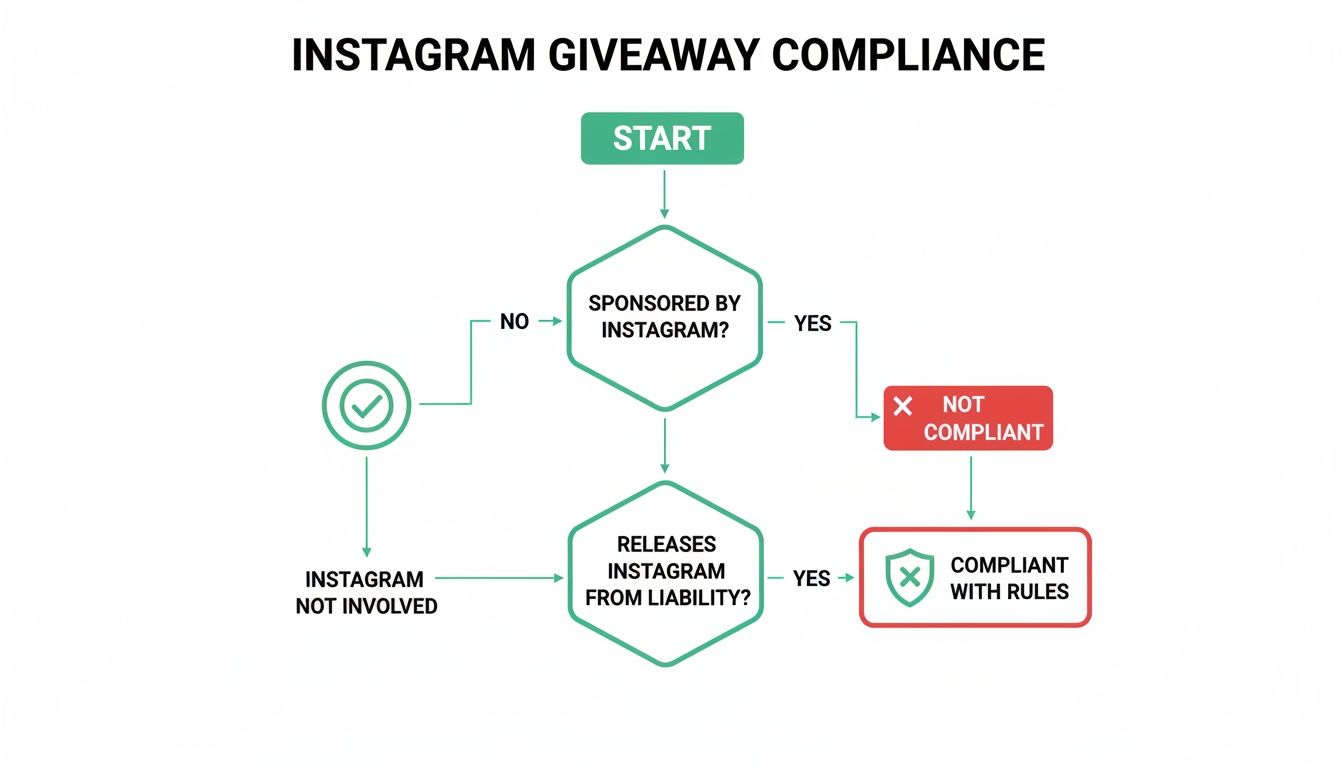
As the flowchart shows, any promotion has to explicitly state it's not sponsored by Instagram and must release the platform from all liability. These are fundamental instagram rules for giveaways.
Sweepstakes vs. Contest vs. Lottery
Okay, this next part is crucial. Understanding the difference between these three terms is probably the most important legal distinction you'll need to make. Getting it wrong can accidentally turn your fun giveaway into an illegal lottery.
Here’s the breakdown:
Illegal Lottery: A lottery has three ingredients: a prize, an element of chance, and consideration (which means requiring a purchase or payment to enter). Asking someone to buy a product for a chance to win a random drawing is a classic example of an illegal lottery in most places.
Sweepstakes: A sweepstakes has a prize and is based on chance, but—and this is the key—there is no consideration. People can enter for free. Most Instagram giveaways (like, comment, and follow to win) fit perfectly into this category, making them legal and safe.
Contest: A contest involves a prize and requires skill, not chance. The winner is picked based on merit, like the best photo or the most creative caption. Because skill is the deciding factor, you can often require a purchase to enter, but this can get tricky depending on where you are.
For most brands, a sweepstakes is the way to go. It’s the simplest and legally safest structure for a social media giveaway. Just make sure you have a clear "no purchase necessary" clause in your official rules.
Heeding Regional and Local Laws
Finally, you have to remember that promotion laws aren't universal. What’s perfectly fine in one state or country might be restricted or outright illegal in another. For example, Quebec, Canada, has famously strict laws for contests, sometimes requiring registration and security deposits for prizes over a certain value.
Because of this legal patchwork, your official rules must clearly state who is eligible to enter. Defining age and location restrictions (e.g., "Open to U.S. residents, 18+ only") protects you from accepting entries from places where your giveaway would be non-compliant. Always specify any voided locations where the promotion isn't valid.
How To Craft Complant Giveaway Entry Methods
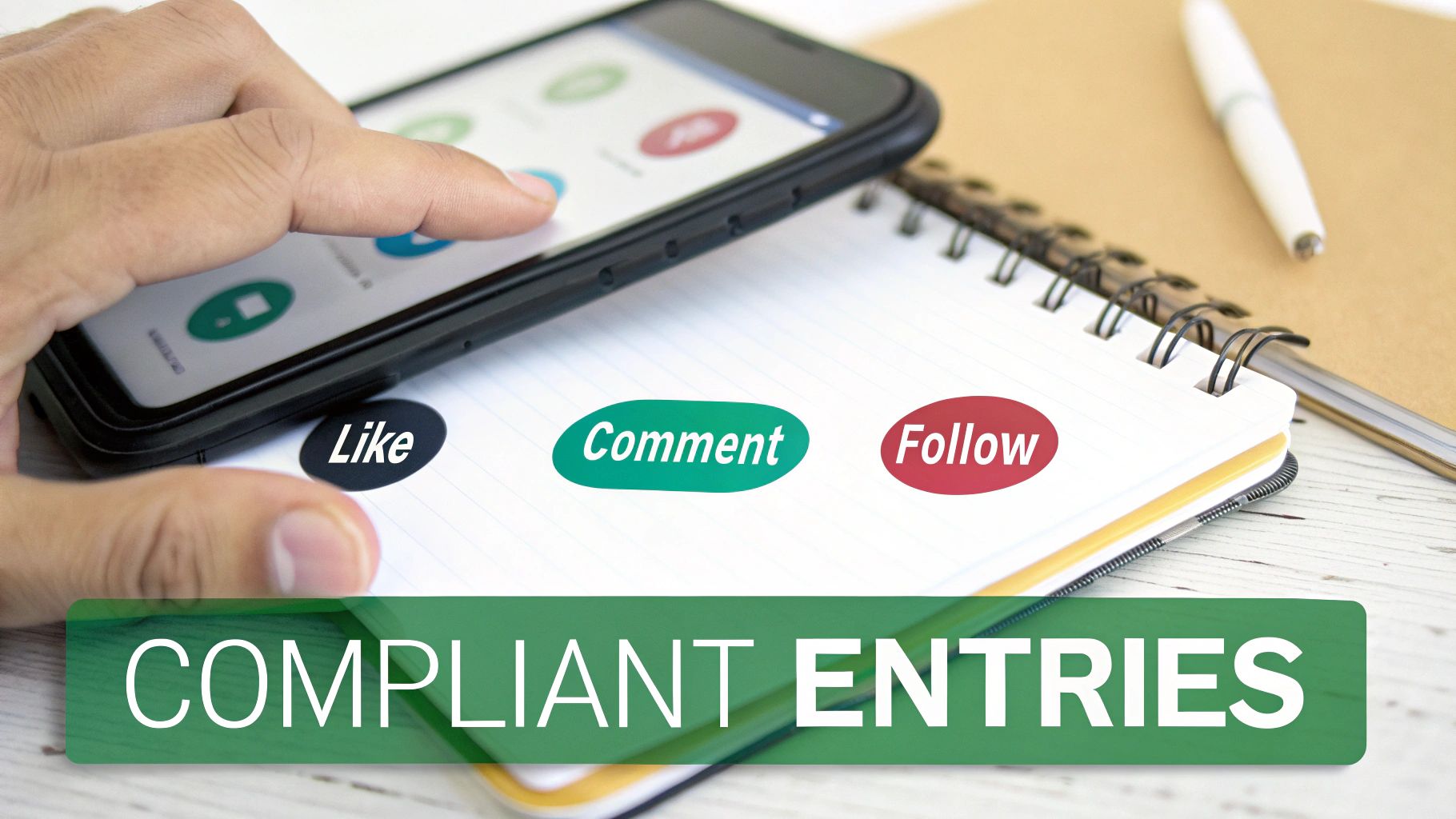
Alright, you've got the legal groundwork and platform rules down. Now it's time for the fun part: designing how people actually enter your giveaway. This is the heart of your campaign.
Think of it as a strategic balancing act. You want to make it easy enough for tons of people to join, but you also want to hit specific marketing goals—all while staying on the right side of the rules. The actions you require, like a follow or a tag, are the engine driving your giveaway's growth.
Balancing Engagement With Simplicity
Here’s the golden rule: keep it simple. The more hoops you make people jump through, the more you'll see them drop off. The most successful (and compliant) giveaways I've seen almost always stick to a basic formula that reliably boosts engagement without confusing anyone.
These are the tried-and-true entry methods:
Follow Our Account: This is the big one. It's the most direct way to grow your follower count with people who are at least interested enough in your prize to stick around.
Like This Post: Asking for a "like" is the lowest-hanging fruit. It’s a super easy way to signal to the Instagram algorithm that your post is worth showing to more people.
Comment on This Post: A comment carries more weight than a like. You can make it more impactful by asking a simple question related to your brand or the prize itself.
Tag a Friend in the Comments: This is pure word-of-mouth gold. Every tag is a personal introduction to a potential new follower, creating a powerful viral loop.
Combine these, and you've got a recipe for success. A simple "Follow us, like this post, and tag one friend" covers all your bases for growth and engagement.
The Trade-Off Between Reach and Quality
While simple entry methods cast a wide net, sometimes you need something more. More complex tasks can attract a more dedicated, higher-quality audience, but you have to understand the trade-offs.
Data shows that simple mechanics (like, follow, tag one friend) typically see participation funnels with a 30%–40% conversion rate. But asking for something complex, like user-generated content (UGC), will drastically lower participation while yielding more valuable assets.
A Tale of Two Giveaways > Imagine Brand A asks users to "Follow and Like" to win a gift card. They get thousands of entries almost overnight, and their follower count explodes. Meanwhile, Brand B asks users to "Post a photo with our product using #OurBrandContest." They get way fewer entries, but they walk away with a library of authentic customer photos they can use in their marketing for months.
Neither approach is wrong; they just serve different goals. If you're chasing explosive, top-of-funnel growth, keep it dead simple. If you need deeper engagement or valuable content, a more involved entry method might be worth the drop-off. You can learn more about how to leverage user-generated content from these campaigns to build powerful social proof.
To help you decide, let's break down the most common entry methods, weighing their effectiveness against the friction and risk they introduce.
Comparison of Common Instagram Giveaway Entry Methods
Following the account is the most direct and effective way to grow your audience because it delivers high-value growth with minimal effort from users. The main risk is attracting prize-hunters who may unfollow after the campaign ends.
Liking a post is the easiest action for users to take and helps boost the post’s visibility in the algorithm. However, it is the lowest form of engagement and does little to build a meaningful connection with your audience.
Commenting on a post sends a stronger engagement signal than a like and can spark real conversation. The downside is that without a strong prompt, comments can become low-effort or appear spammy.
Tagging a friend is excellent for viral reach and discovery because it leverages word-of-mouth sharing. That said, it creates moderate friction, as some users dislike tagging friends and multiple tags can feel intrusive.
Sharing to Stories significantly amplifies reach by placing your content in front of new audiences. This action has high friction, since users are selective about what they post to their Stories, and tracking entries can be challenging.
Creating user-generated content (UGC) produces authentic, reusable content and attracts highly engaged fans. However, it has the highest friction and typically results in far fewer participants due to the extra effort required.
Choosing the right mix from this table depends entirely on what you want to achieve. For most brands, a simple combination of "Follow, Like, and Tag" is the sweet spot.
Structuring Your Call to Action
Your call to action (CTA) needs to be impossible to misunderstand. Don't make people guess. I always recommend using a numbered list right in the caption to break down the entry steps.
Compliant CTA Example:
Want to win our Ultimate Summer Prize Pack? Here’s how to enter:
FOLLOW our page @YourBrand.
LIKE this post.
TAG a friend in the comments below (one tag per comment, unlimited entries!).
This format is scannable, direct, and fully compliant. To make sure your announcements, reminders, and winner reveals go out exactly when they're supposed to, using the best social media scheduler can be a lifesaver for keeping your campaign organized and running smoothly.
The Essential Components Of Your Official Rules
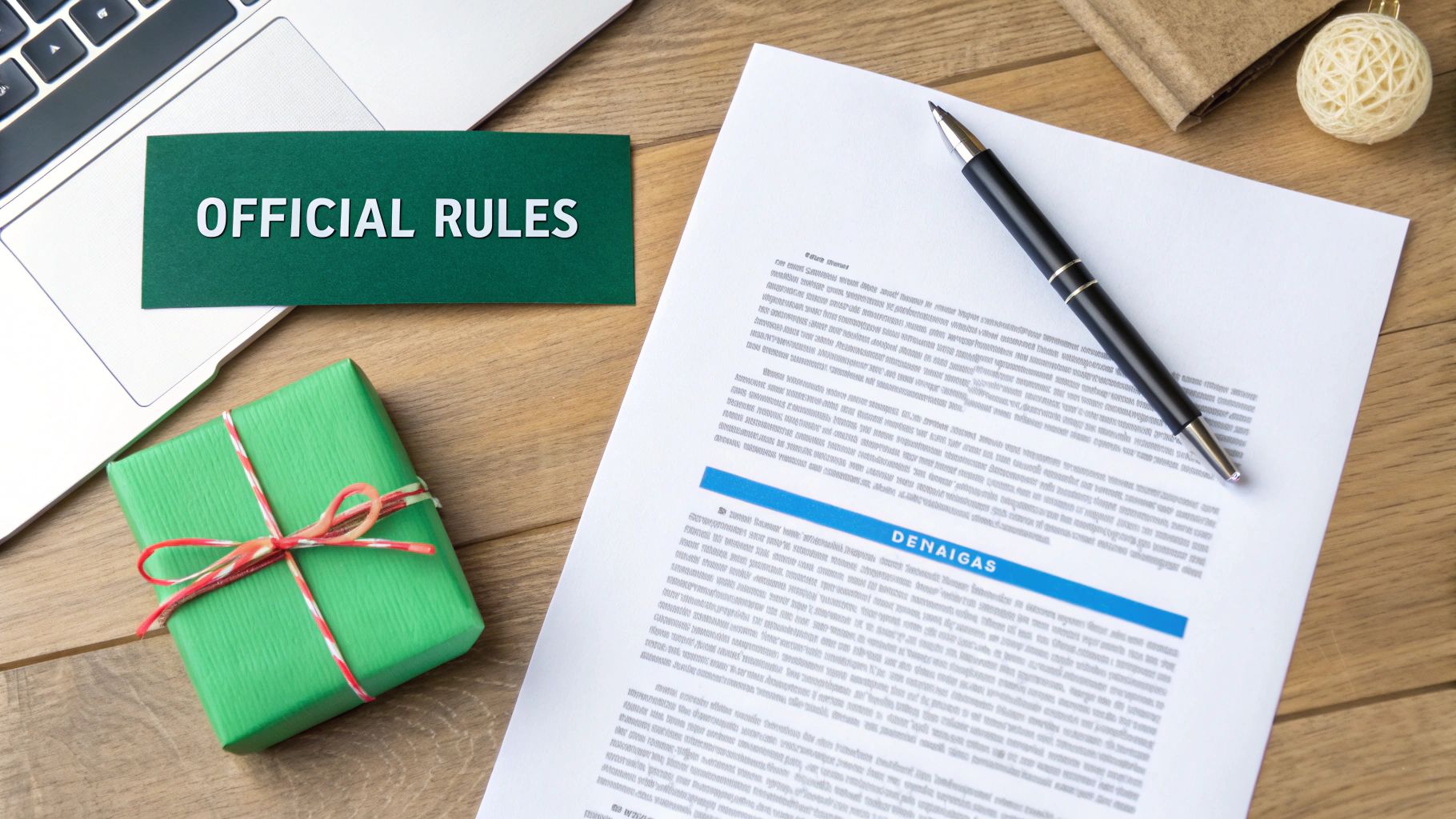
Trying to run a giveaway without a solid set of "Official Rules" is like throwing a party without a start or end time. It’s chaotic, confusing, and pretty much guarantees someone will get upset.
These rules are your contract with every single person who enters. They set clear expectations, protect you from legal drama, and show your audience that you’re a professional brand that plays fair. Think of them as the foundational document that keeps everything running smoothly.
Identifying The Sponsor and Promotion Period
First things first, who is running this giveaway? Your rules need to spell this out clearly under a "Sponsor" section. This means listing your brand's full legal name and address. It might feel like a boring formality, but it’s what establishes legal responsibility.
Next up is the "Promotion Period." You have to be incredibly specific here. Don't just say the giveaway "ends next week." State the exact start and end dates and times, right down to the time zone (e.g., "Begins at 9:00 AM EST on October 1, 2024, and ends at 11:59 PM EST on October 15, 2024"). This precision is your best defense against someone trying to enter after the deadline.
Defining Eligibility Requirements
Sorry, but not everyone can enter your giveaway. The "Eligibility" section is where you lay down the law on who gets to play. This is your chance to comply with local laws and make sure you’re reaching the right audience.
Every eligibility clause should cover these key points:
Age Restrictions: The standard here is 18+ years or older. This isn't an arbitrary number; it's tied to contract law in most places.
Geographic Limitations: Be specific. Are you shipping a prize? You’ll want to limit entry to certain locations (e.g., "Open to legal residents of the 50 United States and D.C.").
Exclusions: It's a classic move for a reason: exclude your own employees and their immediate families. This keeps the contest fair and avoids any appearance of favoritism.
A vague eligibility clause is a magnet for trouble. Nail down these details to protect your brand from legal headaches in places where your giveaway might not be compliant.
Detailing The Prize and Its Value
People enter giveaways because they want to win something cool. Be totally transparent about what that is. Don't just say you're giving away a "prize pack"—list every single item the winner will receive.
Just as important, you have to state the Approximate Retail Value (ARV) of the prize. For example, "One (1) Grand Prize: a Brand X Skincare Bundle (ARV: $250)." This is a non-negotiable legal requirement in many places, especially as prizes get more valuable, because it has tax implications for the winner.
Why the ARV Matters: This isn't just about bragging rights. The ARV is a critical piece of legal information. In the U.S., for instance, prizes valued over $600 often require the winner to file tax forms. Providing the ARV upfront ensures everyone knows what's involved and keeps you on the right side of the law.
Explaining The Winner Selection Process
This part is all about fairness. How, exactly, will a winner be chosen? Your process needs to be crystal clear to build trust and prove your giveaway is legitimate. The method will depend on whether you’re running a random sweepstakes or a skill-based contest.
For a sweepstakes, the gold standard is a random drawing. Your rules should say something simple and direct, like: "One (1) winner will be selected in a random drawing on or about [Date] from all eligible entries received."
If it's a contest based on skill (like a photo contest), you need to define your judging criteria. Get specific! For example: "Entries will be judged on creativity (50%), originality (25%), and relevance to the theme (25%)." The more objective you can be, the better. This is also a great place to let your brand’s personality shine; knowing how to create brand guidelines can help you align your contest criteria with your brand’s unique voice.
Finally, state how you'll contact the winner (an Instagram DM is common) and how much time they have to claim their prize before you move on to an alternate. A clear process here ensures a smooth finish and reinforces the integrity of your instagram rules for giveaways.
Your Top Giveaway Questions, Answered
Even with the best-laid plans, a few tricky questions always seem to pop up right before you’re ready to launch. This is your quick-reference guide for those last-minute head-scratchers about Instagram rules for giveaways. Think of it as your final gut check before hitting "publish."
Getting the hang of all the compliance details can feel like a lot, but most of it boils down to being fair and transparent. Let's clear up the most common points of confusion so you can run your next promotion with total confidence.
Can I Require People to Buy Something to Enter?
This is a hard no. Unless you want to get tangled up in running an illegal lottery, you can never require a purchase to enter your giveaway.
The moment you ask for a purchase (what lawyers call "consideration"), combined with a prize and an element of chance, you've created a lottery. And lotteries are heavily regulated. To keep your giveaway a legal sweepstakes, you absolutely must include a "no purchase necessary" clause. It keeps the entry free and open for everyone and steers you clear of some serious legal headaches.
How Long Should a Giveaway Run?
There’s no magic number here, but the sweet spot for most Instagram giveaways lands somewhere between three and seven days. This window is long enough to build some real momentum but short enough to keep that sense of urgency alive.
Too Short (1-2 days): You risk missing a huge chunk of your audience, especially people who don't log in every single day.
Too Long (2+ weeks): The excitement fizzles out. People see the post, think "I'll do that later," and then completely forget about it.
A week-long run is a solid starting point. It gives you plenty of time to drop reminders in your Stories and build hype without letting the energy die down.
Do I Really Need to Announce the Winner Publicly?
Yes, you 100% should. Publicly announcing the winner isn't just a nice thing to do; it’s a crucial step for building trust. It’s your way of proving to everyone who took the time to enter that the contest was legit and that a real person actually won.
Skipping this step can make your followers feel like they were scammed just for a follow. A simple post tagging and congratulating the winner reinforces your brand's credibility and makes people excited to join your next promotion.
Pro Tip: Once you've announced the winner, go back and edit the caption on your original giveaway post. Add "[GIVEAWAY CLOSED]" right at the top. It's a small tweak that prevents any confusion or late entries trickling in after the fact.
What Happens If the Winner Doesn't Respond?
It happens more often than you'd think! This is precisely why your official rules need to spell out how long a winner has to claim their prize and what you'll do if they go silent. A 48 to 72-hour window is pretty standard.
If your winner doesn't get back to you in that timeframe, your rules should state that they forfeit the prize and that you'll draw an alternate winner. Having this process documented upfront saves you from potential disputes and keeps things moving smoothly.
Can I Partner With Other Brands for a Giveaway?
Not only can you, but you absolutely should! Partnering with complementary, non-competing brands is one of the smartest ways to run a massive giveaway. It lets you tap into a brand new, highly relevant audience and pool your resources to offer a prize package that’s way more enticing than what you could do alone.
When you team up, just make sure all the sponsoring brands are clearly tagged and mentioned in both the post and the official rules. To really make it work, every brand should be cross-promoting the giveaway on their own feed to maximize reach. It's a fantastic way to grow your follower count with people who are already primed to love what you do.
Ready to grow your Instagram audience with followers who are genuinely interested in your brand? Gainsty uses advanced AI and expert strategies to deliver real, organic growth. Stop wasting time with fake followers and start building an authentic community today. Get started with Gainsty now
.png&w=1920&q=75&dpl=dpl_34ZXCf12K5qjjdZjPn9snwDRADrB)



.png&w=750&q=75&dpl=dpl_34ZXCf12K5qjjdZjPn9snwDRADrB)