What Are Instagram Spam Accounts
A creator checks her notifications and sees the same weird pattern every time. “Nice content,” “DM me for a collab,” and a link that doesn't belong are all mixed into the comment thread, while a handful of new followers have no real identity behind them. That's not just annoying noise, it's the kind of activity that can make a healthy audience look inflated and unreliable.
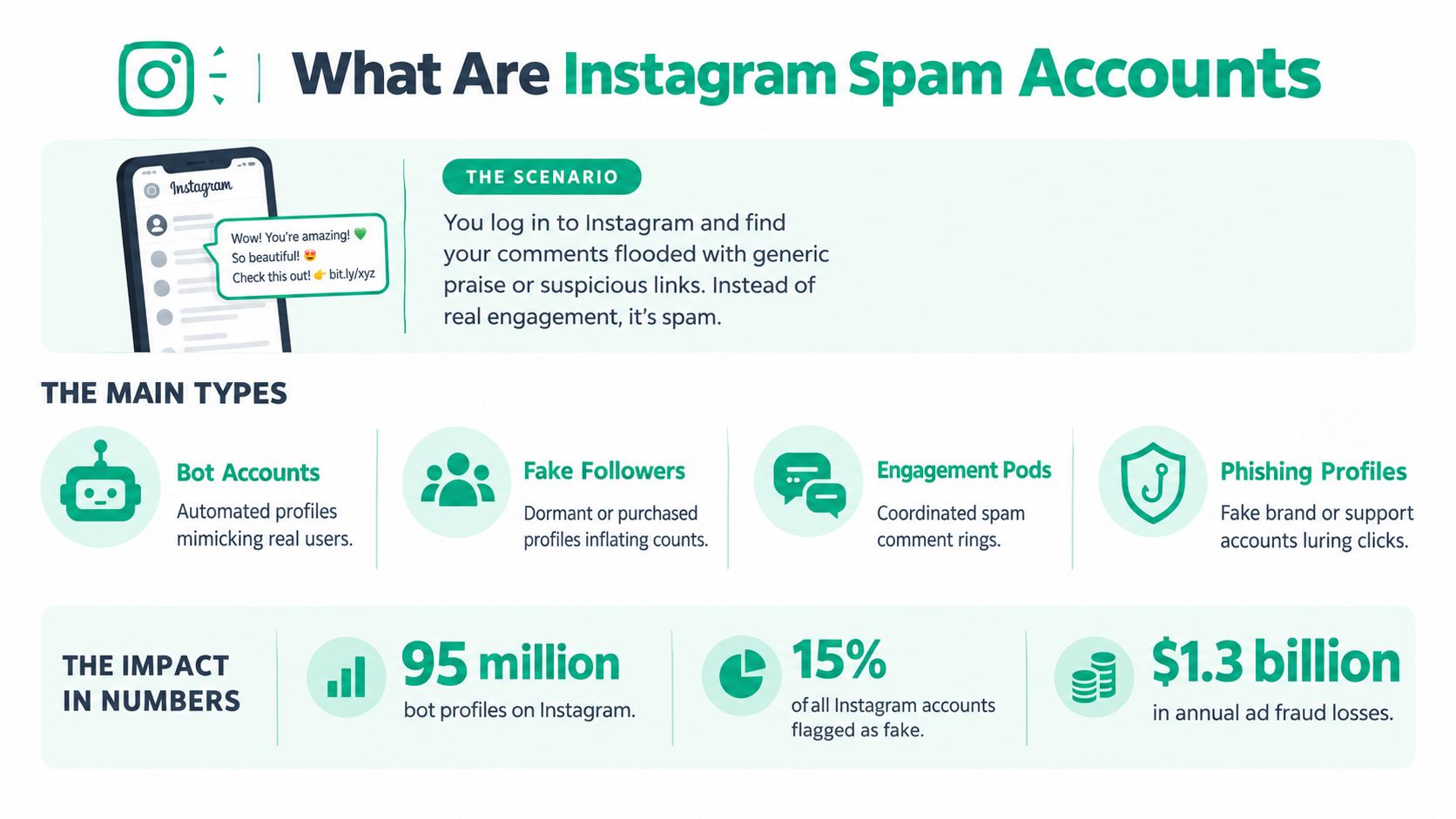
Instagram spam accounts are profiles that exist to mislead, manipulate, or amplify activity without genuine community intent. Some push promotional links, some inflate follower counts, and some are part of larger coordinated networks that try to manufacture popularity or steer attention in a particular direction. Meta's enforcement data shows how large this ecosystem is, with action taken against approximately 1 billion fake accounts in Q1 2025, while spam-content enforcement was far smaller by comparison, which is a strong signal that account-level abuse matters more than one-off junk posts (Meta enforcement data).
For brands, the practical problem isn't only that spam is ugly. It's that fake activity can blur the picture you use to judge content quality, audience fit, and campaign performance. If your engagement is padded by low-quality accounts, the numbers may still move, but they stop telling you anything useful.
Practical rule: if the activity looks repetitive, premature, or disconnected from your niche, assume it's trying to manipulate visibility until proven otherwise.
The most dangerous part is that spam doesn't always look like spam. Some accounts are obvious throwaways, but others are coordinated or partially automated and can slip into a comment section looking almost normal. That's why a basic cleanup pass is never enough on its own.
Types of Fake and Spam Accounts on Instagram
Not every suspicious profile plays the same role. A low-effort bot that posts generic promotional text is annoying, but a coordinated cluster of accounts can make a brand look more popular than it really is, while a compromised real profile can borrow trust from someone your audience already knows.
The obvious and the organized
Some spam accounts are built for volume. They follow, comment, and tag at scale, usually with little effort put into the profile itself. Others are networked, which makes them harder to spot because the activity can look distributed even when it's coordinated behind the scenes. Meta has said fake accounts can be organized into coordinated networks intended to manipulate public discussion or create artificial popularity, not just sit around as isolated promotional spam profiles (Meta transparency reporting).
That distinction matters. A single junk follower is a nuisance, but a network of accounts can distort social proof, invite more low-quality interactions, and trigger engagement that never turns into real interest. If you manage a brand account, the pattern matters more than the profile photo.
The hidden threat is a stolen real account
The hardest accounts to deal with are the ones that used to belong to a real person. A trusted creator, customer, or colleague can get hijacked, and then the spam arrives through a profile that looks familiar enough to lower your guard. That's why a suspicious DM from a known account should be treated differently from a random follower request.
These accounts are dangerous because they carry history. They may have real followers, old posts, and a recognizable name, which gives malicious messages a credibility boost that obvious spam profiles never get.
A real account that changes behavior overnight deserves more caution than a brand-new profile with a bad bio.
If you're triaging a follower list, don't lump every suspicious account together. Separate disposable bots, coordinated engagement rings, and compromised real profiles into different buckets, because each one calls for a different response.
How to Identify Suspicious Instagram Profiles
You'll waste time if you judge accounts by one trait alone. A tiny follower count doesn't prove anything, and a large follower count doesn't guarantee legitimacy. The useful signals are behavioral, not cosmetic, which is why Instagram's own enforcement leans on patterns such as fake engagement, spam, and artificial amplification rather than a single visible marker (Meta enforcement approach).
A practical screening habit starts with three questions. Does the account behave like a person, does it interact in ways that match the content, and does it show any signs of synchronized activity with other profiles? Repetitive comments, bursts of identical language, and sudden shifts in activity across multiple accounts are all stronger warning signs than a polished avatar or a clever username.
One useful research signal came from machine-learning work on 15,000 Instagram profiles, where a model using follower count, following count, posting frequency, and profile-information features reached 97% accuracy at classifying real, bot, spam, and scam accounts (machine-learning study). That doesn't mean you should automate all moderation, but it does show why layered signals work better than one-rule judgment.
What to look at first
Comment timing and repetition: if the same phrasing appears across multiple posts in a short window, treat it as suspicious.
Profile consistency: if the bio, posts, and engagement don't line up, the account may be built for imitation rather than participation.
Interaction patterns: real followers usually vary their behavior. Spam tends to cluster and repeat.
A quick manual review can catch a lot, but it won't catch everything. That's why I keep a simple rule in my own workflow.
Don't ask, “Does this account look fake?” Ask, “Does this account behave like part of a pattern?”
For a practical checklist on profile red flags, this guide to fake Instagram followers is a useful companion when you're doing a fast audit.
The test is whether the account's activity makes sense in context. A small niche account with a few thoughtful interactions can be completely legitimate, while a larger profile pushing repetitive comments across unrelated creators is usually trying to game visibility.
Reporting Spam and Securing Your Account
The response depends on what you're seeing. If it's a visible nuisance follower, cleanup is simple. If it's a familiar account sending strange links or asking for a code, treat it like an incident, not a moderation task.
Start with the public-facing problem first. Block and report accounts that are clearly promotional, repetitive, or impersonating a brand, especially when they're trying to pull people off-platform or into low-trust conversations. Then document the pattern before you remove too much, because aggressive cleanup can erase real prospects if you're too quick with the trigger.
When the issue looks like compromise, shift immediately to account security. Meta warns that attackers who gain access to an account may use it to send spam, and it specifically advises users to reset passwords, log out of unfamiliar devices, and avoid links in messages claiming to be from Meta (Meta security guidance).
A clean response sequence
Verify the source independently. If a known contact sends a suspicious message, confirm it through another channel before you click anything.
Change the password. Do it from a trusted device and make it unique.
Review active sessions. Log out any device you don't recognize.
Check recovery settings. Make sure the right email and phone number are attached.
Report the account or message. Use Instagram's in-app tools when the account is clearly abusive.
Enable stronger authentication. Two-factor authentication adds friction that helps stop repeat compromise.
If you manage a brand account, use outside visibility as part of your response. A resource like Instagram breach data check can help you spot whether a login or identity issue is broader than one suspicious message thread, which is useful when you're deciding whether to treat the problem as spam or security exposure.
For a fuller hardening checklist, keep the how to secure your Instagram account guidance close by, especially if you handle multiple staff logins or creator access.
The biggest mistake is treating every problem as a moderation issue. A spam follower can be blocked. A hijacked account needs access recovery, device review, and a second look at every connected channel that might have leaked credentials.
The Importance of Organic Growth Tools
Spam gets easier to ignore when your audience is healthy in the first place. If most of your reach comes from real people who actually care about your content, fake engagement stands out faster and does less damage to your analytics.
That's where organic growth tools can help, if they're used correctly. The point isn't to stuff the account with activity, it's to keep your audience high-signal so you're less exposed to junk follows and meaningless engagement. In practice, tools like Gainsty focus on authentic targeting and managed growth rather than bot-driven volume, which makes it easier to maintain a cleaner audience over time.
Why signal quality matters
Spam tends to cluster around weak audience filters. When your content reaches the right niche, the ratio of real comments to junk comments usually improves, because the people seeing the post have an actual reason to engage. That doesn't eliminate spam, but it gives you a stronger baseline for spotting unusual activity.
If you're building workflows around content distribution, the guide to social video automation is a useful complement because it focuses on repeatable publishing without relying on low-quality amplification. The same principle applies on Instagram, consistency beats noisy shortcuts.
Organic growth doesn't just attract followers, it improves your ability to notice when something is wrong.
The practical trade-off is simple. A broad, low-quality audience can make vanity metrics rise, but it also makes moderation harder and reporting less trustworthy. A narrower, relevant audience gives you clearer engagement patterns, which means suspicious behavior is easier to isolate and remove.
For teams building a long-term acquisition system, the organic Instagram growth approach is usually the safer baseline because it prioritizes audience fit over empty volume.
Building a Long-Term Spam Defense Strategy
A durable defense isn't about policing every notification. It's about building a routine that keeps the account secure without turning your team into full-time janitors for bad traffic.
Start with a regular audit of comments, followers, DMs, and login access. Watch for shifts in tone, timing, and account behavior, then separate nuisance activity from possible compromise. That distinction keeps you from overreacting to harmless junk while still catching the bigger threat when a trusted profile starts acting differently.
A maintenance routine that holds up
Review suspicious interactions weekly: focus on comment bursts, DM requests, and accounts that repeat the same language.
Check account access monthly: remove old devices, confirm recovery info, and verify who can log in.
Document patterns before removing them: screenshots help if a coordinated wave comes back later.
Keep audience quality high: better targeting makes fake activity easier to see and less able to distort your numbers.
The goal is clarity, not perfection. You won't stop every spam account from appearing, but you can make sure your analytics still reflect genuine community interest instead of noise. If you also care about how your brand appears across channels, professional headshot tips can help keep your profile consistent and credible, which matters more than many realize when users decide whether to trust a direct message or follow request.
A good spam strategy is boring in the best way. It's a set of habits that let you keep growing without losing sight of who's actually engaging with you.
If you want a cleaner Instagram presence without relying on fake followers or bot traffic, Gainsty can help you build organic growth with audience targeting and account management that fits real niche demand. If spam accounts are muddying your analytics or making your brand look less trustworthy, visit Gainsty and see how a more authentic growth system changes the quality of your engagement.
.png&w=1920&q=75&dpl=dpl_2si4hWs7xtpQVmrY6d8xhJ1wLJZL)



.png&w=750&q=75&dpl=dpl_2si4hWs7xtpQVmrY6d8xhJ1wLJZL)