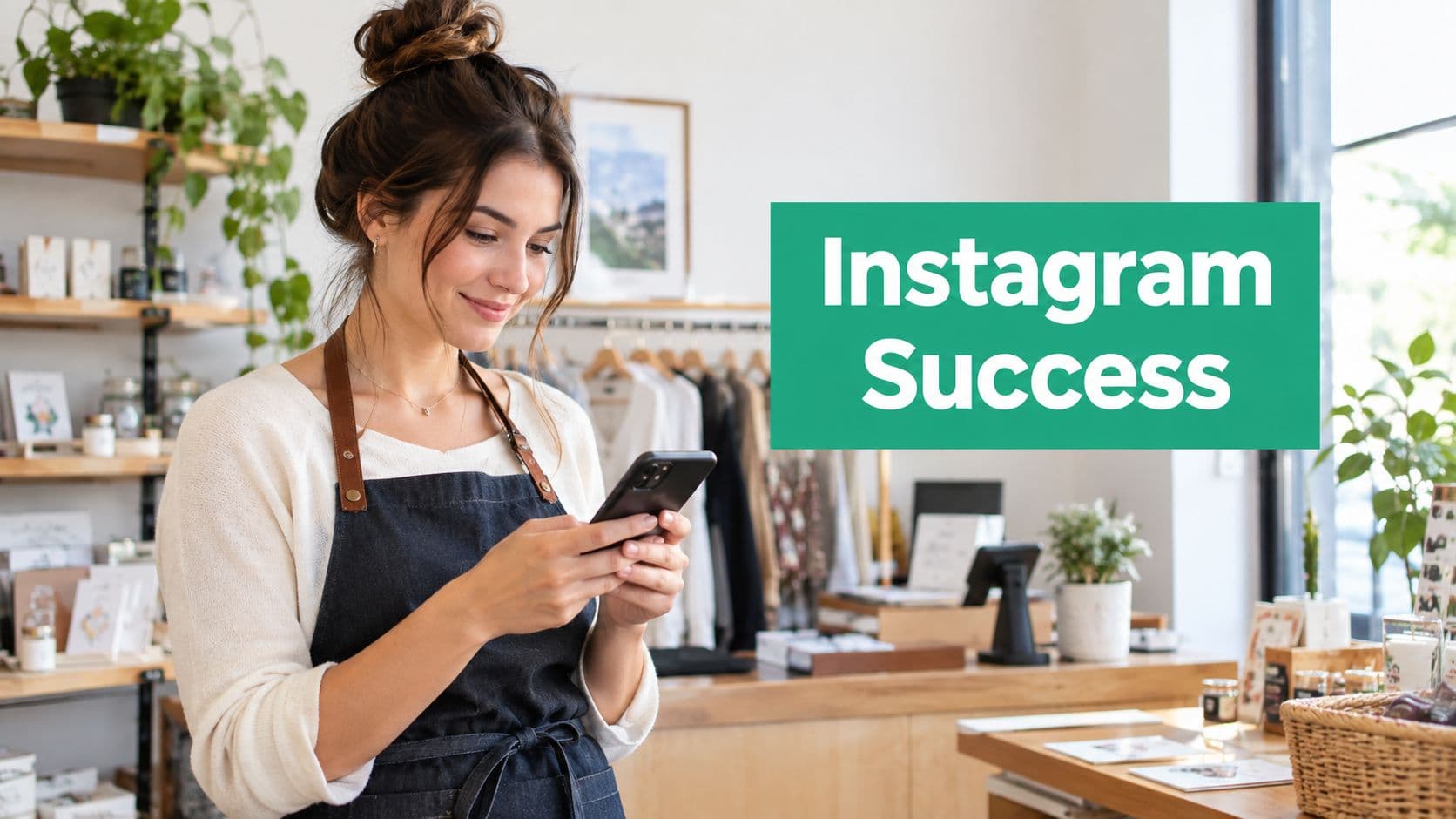
Introduction: Is Instagram Worth Your Limited Time and Budget
A bakery owner opens Instagram before sunrise, sees a competitor's Reel, a customer tag, three unread DMs, and one saved draft. The pressure is obvious. If she posts, she might win new attention. If she skips it, she worries the brand will disappear from people's feeds.
That tension is why so many owners ask whether Instagram is worth the time. The platform can feel like a storefront, a magazine, a customer service desk, and a daily performance stage all at once. It's easy to treat it like a yes-or-no question, but that usually leads to the wrong decision.
The better question is good for what outcome. Instagram can help with discovery, credibility, and sales, but not every business needs the same mix of those three. A local salon and a bookkeeping firm may both use Instagram, yet they may be trying to win very different outcomes from the same app.
Practical rule: if you can't name the outcome, you can't measure whether Instagram is helping.
That matters because the platform is widely used by businesses and consumers, but popularity alone doesn't guarantee fit. The test is whether your customers already browse there, whether your offer can be shown well there, and whether you have a realistic path from post to action. If the answer is yes on at least one of those, Instagram may be worth the effort. If the answer is no across the board, it may still be useful, but only as a supporting channel rather than a primary growth engine.
Why Instagram Looks Built for Small Business Discovery
A small business can treat Instagram like a busy digital high street. People stop, compare, save, and move on. That makes the platform useful for discovery because many users already browse it with a commercial mindset.
The scale is hard to ignore. One marketing roundup says Instagram has more than 2 billion monthly users, and that nearly a quarter of the world's population uses the app each month (Instagram marketing statistics roundup). Another source reports that Instagram has over 350 million business accounts, with roughly 65% belonging to small and medium businesses rather than large enterprises (Hootsuite Instagram statistics).
For a small brand, that means you are not posting into a tiny corner. You are entering a mainstream business setting where people expect to see products, services, and proof of work. The scale also makes low-cost testing possible. You can try a few post styles, watch what gets saved or shared, and learn without building a large media budget first.

Why the business presence matters
A platform can have a large audience and still be weak for small business marketing if people do not use it for commercial purposes. Instagram clears that bar. Multiple marketing summaries report that 80% to 90% of users follow at least one business account, and one benchmark says 81% use Instagram to research new products and services (Hootsuite Instagram statistics).
That is the test. People are there, and many of them arrive in a buying mindset.
Another useful signal is how often people interact with business content. The same research stream says over 200 million people engage with at least one business account daily (Hootsuite Instagram statistics). For a small business, repeated interaction matters because trust rarely comes from one post. It usually grows through a sequence of small touchpoints: a Reel, a Story, a profile visit, a DM, then a purchase or booking.
Instagram works less like a billboard and more like a shop window. Someone can glance once, come back later, and decide when they are ready.
The result is straightforward. Instagram is built for awareness and early consideration, which is often the stage where small businesses need the most help.
What Instagram Does Well and Where It Falls Short
A small business gets the most out of Instagram when the goal is discovery, trust, or a first conversation. The app works well for products or services people want to see, compare, or inspect before they buy. That makes it a strong fit for brands with visuals, before-and-after proof, quick demos, or a clear personality.
Video also tends to outperform photos for engagement in the source set, and Instagram is built to reward formats that people save, share, and revisit. Hootsuite Instagram statistics point in that direction. For a small business, the lesson is simple. You are not always trying to close a sale in one post; you are trying to stay memorable long enough for the next tap, DM, or profile visit.
What it does well
High commercial intent. People often open the app to browse, compare, or confirm whether a business feels credible.
Visual storytelling. Products, spaces, transformations, and people are easy to show.
Direct connection. Comments and DMs create a human path that can feel less formal than email or a website form.
Instagram also supports repeated touchpoints. A Reel can start interest, a Story can answer a question, and a DM can carry the conversation forward. That is why the platform often fits early-stage discovery better than immediate closing.
Where it falls short
Organic visibility is limited. Unpaid reach is often tight, so followers do not all see every post.
It takes time. Visual content, captions, replies, and Stories all ask for steady attention.
Growth is not automatic. Posting often does not guarantee traction.
The trade-off becomes clearer when you separate attention from action. A post can get views and still fail to create inquiries. A smaller account can still do useful work if it turns attention into profile visits, DMs, or bookings.
If your goal is lead generation on Instagram, the platform helps most when each post gives people a clear next step. A practical overview of that workflow is lead generation on Instagram, especially for connecting comments and DMs to real inquiries.
The Real Cost in Time, Money, and Organic Reach
Instagram can feel inexpensive because the app itself costs nothing. The expense shows up in the hours behind each post, captions, replies, visual planning, and the steady work of keeping the account active. For a small business owner, the bill is usually paid in attention before it is paid in cash.
That matters because follower count can hide more than it reveals. A larger audience does not automatically mean more visible posts, and a smaller account can still drive profile visits or DMs when the content matches what people want. The better question is simple: does the account create business action, or just activity?
What low reach changes
Organic reach on Instagram is often limited for smaller accounts. Independent discussion of small-business performance often points to organic reach estimates around 2% to 3% in 2025, and Metricool's 2026 study found that only 21% of accounts under 10,000 followers grew in 2026 (Metricool Instagram study 2026). That does not mean the platform is unusable. It means smaller accounts start with a headwind.
A useful way to read that is to treat Instagram as a top-of-funnel discovery and conversion-support channel, not a machine that prints reach on demand. A post has to lead to a profile visit, then a tap, then a DM or booking. The short analysis of organic reach on Instagram makes the same point in plain terms, visibility is limited, so the path from attention to action has to do more work.
What sustainable effort looks like
A lean team usually gets better results from a manageable posting rhythm than from a burst of energy followed by silence. That means choosing a few repeatable content types, replying on time, and checking which posts lead to profile actions. It also means accepting a more modest win: steadier inquiries, stronger recall, or more direct messages can matter more than fast follower growth.
Practical rule: if your Instagram plan depends on constant inspiration, it will probably collapse under normal business pressure.
The question is not whether you can post more. It is whether the time you spend on Instagram creates enough useful action to justify the effort.
Which Small Businesses Win Most on Instagram
Instagram usually gives the clearest return to businesses people can understand at a glance, or to businesses tied to a place. Restaurants, salons, gyms, med spas, and retail stores fit that pattern well. Customers can see the offer quickly and picture how they would use it. A haircut, a plated dish, a product display, or a workout class is easier to judge on a feed than a complicated back-office service.
Less visual businesses can still use it, but the job changes. For a consultant, accountant, or agency, Instagram often works as a trust layer first and a direct response channel second. It helps someone think, “This business feels credible,” even if the final sale happens by phone, email, or a different page.
For a restaurant or cafe, Instagram is mainly a discovery channel that builds appetite appeal and drives more local awareness and visits.
For a salon, gym, or med spa, it works best as proof of transformation, which can lead to more consultations, bookings, and repeat interest.
For a retail shop, Instagram helps showcase products and seasonal offers, leading to more browsing, saves, and store visits.
For a local service business, the platform is usually most useful for trust-building and lead support, which can improve credibility and increase inbound inquiries.
For a professional service firm, Instagram often plays an authority and brand-familiarity role, strengthening trust even when direct last-click sales stay weaker.
That list is the answer to: Is Instagram good for small businesses? The question is whether your offer can be shown visually, found socially, and explained fast enough to keep attention.
If yes, Instagram can do useful work. If not, it can still help, but mainly as support.
For location-based brands, Instagram for local businesses works best when posts connect to nearby people, neighborhoods, and events. If you are thinking about paid promotion too, the advertising tips from the Veo3 AI piece are useful for pairing organic content with promotion without turning every post into a sales pitch.
How to Measure Success Beyond Likes and Followers
Likes are easy to count and easy to overvalue. A post can get polite engagement and still do nothing for the business. For small businesses, the better signals are the actions that show attention turning into intent.
Track the actions that matter
Instagram's native analytics make it possible to look at saves, shares, profile visits, website taps, and contact-button clicks, which are more useful for revenue attribution than follower growth alone (Instagram analytics for small business). Those are the signals that tell you whether people are moving closer to a decision.
Saves show the content felt useful enough to keep.
Shares suggest the post had enough value to forward.
Profile visits show curiosity about the business itself.
Website taps point to stronger intent.
DMs and inquiries show the strongest hand-raise in most small-business accounts.
The benchmark context helps here too. Typical business engagement is often modest relative to audience size, so low per-post engagement is not automatically a failure. Instagram works best when you treat it as a funnel, not a scoreboard. If a post earns a few saves and drives profile visits, that may be more useful than a higher-like post that goes nowhere.
The cleanest way to manage this is to connect content to a next step. That could be a booking link, a product page, a contact form, or a DM prompt. The more specific the path, the easier it is to tell whether Instagram is contributing to business outcomes.
Social media ROI calculator and campaign success guidance is helpful if you want to compare Instagram effort against actual return instead of guessing. Measurement is where a lot of small businesses realize the platform is working in a quieter way than they expected.

Your Next Steps to Decide and Test Instagram Smartly
The smartest way to decide on Instagram is to stop asking whether it's good in general and start asking whether it's good for your business model. If your offer is visual, local, appointment-driven, or trust-sensitive, the platform has a strong case. If your offer is hard to show and hard to buy quickly, Instagram may still help, but mostly as support.
Use a short decision filter:
Can customers understand what you sell from a post or profile in seconds?
Can you make your work look credible without huge production costs?
Do people already use Instagram to research businesses like yours?
Can you track DMs, visits, taps, or bookings without guessing?
If you answer yes to most of those, run a focused test instead of making a forever decision. Post consistently for a month, use a small set of repeatable content themes, and review what creates profile actions, messages, and clicks. If the account generates useful intent, keep going. If it mainly creates pressure and no traction, reduce it to a trust layer or step back.
The goal isn't to win Instagram. The goal is to make sure the time you spend there connects to the rest of your marketing. A small business doesn't need every channel to be a hero channel. It needs each channel to earn its place.
If you want a clearer way to build organic Instagram momentum without wasting hours guessing what to post, Gainsty helps small businesses organize growth around audience targeting, analytics, and account management. It's a practical option if you want to treat Instagram as a real acquisition channel and not just another app demanding attention.
.png&w=1920&q=75&dpl=dpl_D59Qa4oJ5cFQ7dZDLQ1JPQVnqHSs)



.png&w=750&q=75&dpl=dpl_D59Qa4oJ5cFQ7dZDLQ1JPQVnqHSs)