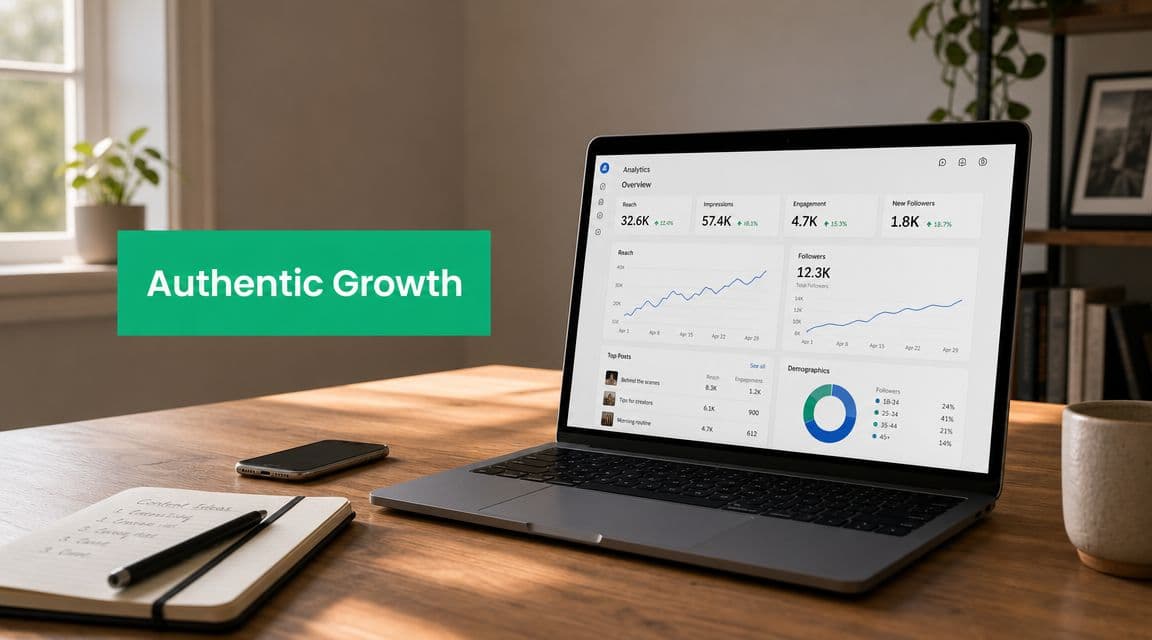
The Plateau and the Promise of Growth
A familiar pattern shows up after the early momentum wears off. In the beginning, growth often feels natural. Friends follow. Early customers engage. A few posts get shared. Then the plateau hits.
Now every new follower seems expensive in time. You post more often, but the results don't move much. You reply to comments, test hashtags, collaborate when you can, and still feel like you're guessing. At that point, “growth software” starts to look like relief.
For many people, the first encounter with social media growth software happens in that exact mood. Tired. Curious. Slightly skeptical.
One option says it can automate your outreach. Another says it can find your ideal audience. Another promises deeper analytics, better timing, and easier reporting. They all use similar language. They do not all do the same thing.
Practical rule: If a tool makes growth sound effortless, slow down and inspect how it works.
That's where smart teams get tripped up. They assume “growth” means any increase in followers or engagement. It doesn't. Real growth means attracting people who fit your audience, respond to your content, and stay connected over time. Inflation means boosting visible numbers without improving audience quality.
A creator with a smaller, responsive audience is in a stronger position than an account with a bloated follower count and weak interaction. The same is true for a local business, a coach, a SaaS founder, or a real estate professional. If the audience doesn't care, the metric doesn't help.
The promise of good software is real. It can save time, sharpen decisions, and make your marketing less reactive. The peril is real, too. Some tools optimize for vanity metrics because vanity metrics are easy to sell.
That's why the buying decision isn't really about software first. It's about philosophy. Are you trying to build attention you can trust, or numbers you need to explain away later?
What Exactly is Social Media Growth Software
Social media growth software is a broad category. It doesn't mean one specific kind of app. It includes tools for publishing, analytics, listening, reporting, engagement, and sometimes audience targeting.
At a basic level, it's much like a cockpit. You still have to fly the plane, but the cockpit gives you instruments, controls, and warnings you wouldn't want to operate without. On social media, that means one system helps you see what you posted, how people responded, where reach is coming from, and which channels deserve more effort.
By October 2025, there were about 5.66 billion social media user identities worldwide, and the United States spent $72.3 billion on social media advertising in 2023, according to Statista's overview of social networks. At that scale, software for analytics, reporting, and audience growth stopped being optional for serious teams.

The main categories inside the label
Some tools focus on scheduling and publishing. These help you plan posts ahead of time, manage approvals, and keep content consistent across platforms.
Others focus on analytics and reporting. These pull together metrics like reach, engagement, clicks, and conversions so you can compare channels instead of checking each app separately.
A third group centers on engagement and monitoring. These tools help teams track mentions, comments, inboxes, and live conversations. That matters when response speed and conversation quality influence visibility.
Then there are specialized growth services. These are the trickiest to evaluate because some are built around safe audience discovery and human-led workflows, while others lean on automation tactics that edge toward spam.
Why the category keeps expanding
Modern tools are also increasingly multi-platform. Buffer's review of analytics tools describes coverage across networks including Facebook, Instagram, LinkedIn, TikTok, X, YouTube, Pinterest, and Threads, with pricing that ranges from free tiers to premium plans such as Buffer starting at $6 per month, Social Status at $99 per month, and Rival IQ at $239+ per month, as outlined in Buffer's guide to social media analytics tools.
That range tells you something important. Social media growth software now covers everything from lightweight scheduling to full decision systems for content, engagement, and performance analysis.
If your bottleneck is content production, a dedicated social media content creation tool can sit alongside your analytics stack instead of replacing it. If your bottleneck is audience development or cross-platform workflow, you'd look at a different layer of tools, including guides to social media growth tools.
Good software doesn't replace strategy. It makes strategy visible, repeatable, and easier to refine.
The confusion usually comes from expecting one tool to do everything. Many organizations don't need that. They need the right combination of publishing, measurement, and engagement support for the stage they're in.
The Two Approaches to Growth: Fully Organic vs. Automation-Assisted Systems
The most useful distinction in this space isn’t simply “good tools vs bad tools.” It’s understanding how growth is actually supported—ranging from fully manual, content-led strategies to systems that use automation to improve consistency, efficiency, and scale.
This distinction matters because it shapes audience quality, engagement depth, and how sustainable growth is over time.

Fully organic growth
Fully organic growth is driven entirely by human effort: creating content, engaging with audiences, responding to comments and messages, and building relationships over time.
It tends to produce highly aligned and loyal audiences, but it often requires significant time and consistency to scale.
Automation-assisted growth
Automation-assisted tools are designed to support, not replace, human-led growth. They help creators and teams stay consistent, reduce manual workload, and make better decisions about where to focus attention.
Used responsibly, they can strengthen organic growth by improving visibility, timing, and workflow efficiency—especially across multiple platforms.
This can include things like audience insights, content performance analysis, engagement management workflows, and cross-platform reporting.
How different systems typically differ in practice
In reality, growth approaches sit on a spectrum:
Goal: Organic systems focus on relevance and long-term audience fit, while more automation-driven systems prioritize speed and scale
Method: Organic approaches rely on content and human engagement; assisted systems add structure, insights, and workflow automation
Audience quality: Organic tends to be more targeted, while broader automation can expand reach more quickly but with varying relevance
Outcome: Organic growth builds slower but compounds over time; automation-assisted approaches aim to improve efficiency while still supporting long-term growth
Industry guidance also points out that effective social media management software combines scheduling, monitoring, analytics, listening, collaboration, and integrations, rather than treating growth as a follower-only game, as explained in Info-Tech's social media management software selection guide.
If you can't explain where followers are coming from and why they fit your audience, you're probably looking at inflation, not growth.
There's also an operational gap many buyers miss. Broad software guides often focus on publishing and analytics, but not on the exact bottleneck that's holding growth back. Some teams need a scheduler. Others need better reporting. Others need an engagement layer that helps them spot and respond to conversations quickly. That gap is discussed in PowerIn's breakdown of social media growth tools.
That's why “automation” isn't automatically bad. Safe automation handles publishing, reporting, notifications, organization, and workflow. Risky automation impersonates human interaction in ways that damage data quality and account health.
The Benefits and Hidden Risks
A good growth tool should make your account easier to run and easier to trust. A bad one can make the numbers look better while making the account weaker underneath.
That distinction matters because growth and inflation are not the same thing. Growth adds audience fit, clearer feedback, and more useful signals. Inflation adds bulk. It can raise the follower count while lowering the value of everything you measure after it.
What good software improves
Useful software brings clarity first. It helps you see which posts attract the right people, which conversations lead to action, and which channels deserve more attention. That is the difference between driving with a clean windshield and driving through fog.
It also improves consistency. Content gets scheduled on time, approvals stop living in scattered messages, and reporting becomes easier to review. Many brands do not struggle because they lack ideas. They struggle because execution breaks down between planning, publishing, and follow-up.
Good tools also support better decisions. If your software shows how content themes connect to replies, clicks, saves, leads, or sales activity, you can spot patterns with more confidence. You stop judging success by surface-level motion alone.
There is also a practical benefit on the operations side. Different tools serve different jobs. Some focus on publishing. Some focus on analytics. Some help teams manage replies and conversations at scale. The value comes from matching the software to the bottleneck, not from collecting features you may never use.
Where the hidden risks show up
The first risk is using the wrong scoreboard.
If a platform highlights follower totals but gives weak visibility into audience quality, engagement relevance, or conversion signals, it can push you toward inflation without saying so directly. That is how teams end up celebrating numbers that do not help the business.
The second risk is trust erosion. Robotic comments, awkward follow patterns, and irrelevant interactions leave a residue. Even if no one says, "this account feels fake," people notice when behavior feels off. Trust erodes subtly, and trust is harder to rebuild than to reach.
A third risk is bad data. Once low-fit or fake followers enter the account, your reporting gets harder to read. Engagement rates become less useful. Content tests produce weaker signals. Audience insights lose precision. If you want a practical way to vet suspicious audience patterns, this guide on how to spot fake Instagram followers can help.
A growth tool should improve signal. If it adds noise, it makes decisions harder.
That is the hidden cost many buyers miss. Inflation does not only pad a vanity metric. It can distort content strategy, weaken brand trust, and make a healthy account look successful on paper while performance gets less reliable in practice.
How to Choose the Right Social Media Growth Software
You log into your account after a month with a new tool. Follower count is up. Comments look thin, saves are flat, and profile visits have not changed much. That is the moment many buyers realize they did not buy growth. They bought inflation.
That distinction should guide your whole evaluation process. Good software helps you attract the right people, learn from their behavior, and repeat what works. Weak software pads numbers that look impressive in a screenshot but do little for reach, trust, or sales.

Start by checking how the tool creates results
A careful buyer should ask about the method before the features.
If a vendor cannot explain, in plain language, how people discover your account, who gets targeted, what gets automated, and where human review still matters, stop there. Vague phrases like “smart growth engine” or “proprietary system” often hide the part you need to inspect.
Ask for direct answers on three points:
Platform compliance: Do they clearly avoid bots, fake followers, and mass-action behavior?
Workflow clarity: Can they explain what the software does and what a person still needs to monitor or approve?
Security practices: How do they handle login access, account permissions, and privacy?
A trustworthy vendor should sound more like a good operator than a magician.
Match the software to the problem you actually have
Social media tools fail buyers when they solve the wrong problem well.
If your team struggles to post consistently, a scheduling and approval tool may help. If content is going out but you cannot tell which posts bring qualified traffic, you likely need stronger reporting. If you get attention from the wrong audience, targeting and audience analysis matter more than publishing volume.
That is why “all-in-one growth” claims deserve caution. A Swiss Army knife is useful, but not if what you need is a chef's knife. Buying the wrong bottleneck usually leads to more dashboards, more cost, and very little progress.
Judge reporting by whether it helps you make better decisions
Strong analytics should answer practical questions. What content attracts the right audience? Which channel brings attention that turns into clicks, replies, or conversions? What should you change next week?
Look for reporting that shows:
Audience quality signals: engagement relevance, profile actions, clicks, saves, replies, or other signs of genuine interest
Cross-channel context: a way to compare performance across the platforms you use
Clear feedback loops: guidance on timing, content format, audience segments, and campaign adjustments
Price can hint at what kind of tool you are buying, but cost alone does not tell you whether the product supports real audience building. Lower-cost tools often focus on scheduling and basic publishing. Higher-priced platforms usually add collaboration, reporting, and deeper workflow controls. The point is not to spend more. The point is to pay for the layer you need.
If you want to compare reporting-focused options first, this guide to social media analytics software is a useful place to start.
Putting Theory into Practice with Gainsty
The biggest gap in this market isn't a lack of tools. It's a lack of clear guidance for buyers who want Instagram growth without drifting into bot behavior.
That gap matters because newer strategy advice around Instagram and adjacent platforms puts more weight on authentic discovery, collaboration, and audience fit than on brute-force automation. Socialinsider highlights this broader shift in its discussion of social media growth strategies, especially around the challenge of scaling organic growth in an anti-bot environment.

A practical way to judge any specialized service is to run it through the checklist from the previous section.
What to look for in a service model
First, the service should be clear about not using bots or fake followers. If the language is fuzzy, assume the risk is higher than it sounds.
Second, there should be some combination of targeting, reporting, and human oversight. Software alone can organize data. Growth decisions still benefit from context, especially when your audience is niche.
Third, the product should be able to support different use cases without pretending every account grows the same way. An influencer trying to attract brand-aligned followers has a different operating reality than a real estate professional trying to reach a local market.
One example in this category is Gainsty, which is positioned as an Instagram growth service that combines AI support with human expertise, audience targeting, analytics, and account management. That matters because a key market need is software that helps scale authentic Instagram growth without relying on bot-style shortcuts.
How this looks in the real world
For a creator, the useful question isn't “Can this tool get me more followers?” It's “Can it help me attract the type of follower who watches, replies, shares, and sticks around?”
For a local business, the question becomes more specific. Can the service help focus on the right geography, related audiences, and content feedback so visibility improves with the people most likely to care?
For a consultant or founder, trust is even more fragile. Inflated numbers can make an account look polished at first glance, but the comments, message quality, and overall interaction usually reveal whether the audience is real.
That's the practical value of keeping growth tied to authentic audience building. You aren't just protecting your account. You're protecting the meaning of your metrics.
Build an Audience, Not Just a Follower Count
The central mistake in this category is confusing visible movement with real progress.
A follower count can rise while audience quality falls. Engagement can look busy while trust erodes. A dashboard can feel encouraging while the business impact stays flat. That's inflation. It looks like momentum from a distance and creates very little value up close.
Authentic growth is less flashy, but it's sturdier. It gives you an audience you can learn from, create for, and convert over time. It helps you understand what people respond to and why. It keeps your account aligned with the way platforms increasingly reward relevance, consistency, and real interaction.
If you're trying to grow your social media brand, keep that distinction in front of you. Choose tools that improve judgment, not just output. Choose software that helps you see your audience more clearly, not software that muddies the picture with vanity metrics.
The safest path is also the one that holds up longest. Build a real audience. Protect your credibility. Treat every “growth” promise as a method to inspect, not a result to trust on faith.
If you want a safer path to Instagram growth, try Gainsty today, which focuses on organic growth with human support and customizable targeting.

.png&w=1920&q=75&dpl=dpl_34ZXCf12K5qjjdZjPn9snwDRADrB)





.png&w=750&q=75&dpl=dpl_34ZXCf12K5qjjdZjPn9snwDRADrB)