Decoding Social Media Management Costs

Trying to compare social media management pricing packages often feels like comparing apples to oranges. The costs are all over the map because the services are, too. You aren't just paying for someone to schedule a few posts. You're investing in strategy, content creation, community engagement, analytics, and reporting.
Think of it like buying a car. You can get a basic model that gets you from A to B, or you can opt for the fully-loaded version with all the bells and whistles. Social media packages work the same way, with tiers designed to match different business goals. Social media is a huge piece of the puzzle, but it's important to see how it fits into a comprehensive content marketing strategy to really understand its value.
Typical Investment Levels
So, what should you actually budget? The cost of hiring a social media manager can swing pretty wildly depending on whether you're bringing on a freelancer or a full-service agency. Here's a quick breakdown of what businesses like yours are typically spending.
To give you a clearer picture, we've broken down the average monthly costs for social media management based on common business sizes and the level of service you can expect at each price point.
Average Monthly Social Media Management Costs By Business Size
Solopreneur / Freelancer
Basic Package (Starter): $500 - $1,500
Standard Package (Growth): $1,500 - $3,000
Premium Package (Scale): $3,000 - $5,000+
Small Business (2–10 Employees)
Basic Package (Starter): $900 - $2,500
Standard Package (Growth): $2,500 - $5,000
Premium Package (Scale): $5,000 - $10,000+
Medium Business (11–50 Employees)
Basic Package (Starter): $1,500 - $4,000
Standard Package (Growth): $4,000 - $7,500
Premium Package (Scale): $7,500 - $15,000+
Large Business (50+ Employees)
Basic Package (Starter): $3,000 - $6,000
Standard Package (Growth): $6,000 - $12,000
Premium Package (Scale): $12,000 - $25,000+
These numbers aren't set in stone, but they provide a solid starting point for budgeting. As you can see, the investment grows as your team and your needs become more complex.
The goal isn't just to find the cheapest option. It’s about finding the package that delivers the best return on investment by aligning perfectly with your actual business goals.
Ultimately, the right package is the one that helps you grow. Use these figures as a guide to frame your budget and start conversations with potential partners.
When you start looking for someone to manage your social media, you’ll see that freelancers and agencies tend to price their work in a few common ways. Getting a handle on these four main models is the first step in determining what fits your budget and what you’re trying to achieve. Each one has its own vibe and works best for different kinds of partnerships.
Think of it like hiring a personal trainer. Do you want them on call all month? Just for a few specific sessions? To crush one big fitness goal? Or do you only want to pay when you hit a new personal best? Let’s dive into what these models actually look like in practice.
The Monthly Retainer Model
The monthly retainer is, by far, the most common setup you'll come across. It’s essentially a subscription for your social media marketing—you pay a set price every month for a clearly defined list of services. This makes your marketing budget predictable and keeps your social media efforts from fizzling out.
This model is a fantastic fit for businesses that are committed to the long term and seek a consistent, ongoing partnership. Everything is agreed on upfront, so you know exactly what you’re getting each month, from creating and scheduling posts to managing your community and sending over reports. Most agencies love this model because it lets them really dig in and build a solid strategy with your brand over time.
For example, a $2,500 monthly retainer might get you:
Management for three platforms (like Instagram, Facebook, and LinkedIn).
20 original posts per month, complete with custom graphics.
Daily community engagement and comment moderation.
A detailed monthly performance report and a strategy call to go over it.
A structure like this gives both you and your provider stability, creating a real partnership built on steady momentum.
The Hourly Rate Model
On the flip side, paying an hourly rate is more like calling a plumber or an electrician. You’re paying for the exact time the social media manager spends working on your accounts. This offers a ton of flexibility, which is great for businesses that don't need someone watching their social media around the clock.
Hourly billing is perfect for specific, one-off tasks. Maybe you just need help setting up your profiles correctly, running a quick audit of your existing accounts, or training your internal team. The rates can be all over the map, from $50 an hour for someone just starting out to $250+ an hour for a top-tier consultant. The biggest catch? Your costs aren't predictable. If a task ends up being more complicated than you thought, the bill can climb fast.
The Project-Based Pricing Model
Project-based pricing is for a single job with a clear finish line. Think of it like hiring a contractor to build a deck—you agree on one price for the whole thing, from start to finish. This model is ideal for distinct campaigns, like a new product launch, promoting a big event, or a seasonal marketing blitz.
With this approach, the price is locked in for the entire project, so there are no surprise costs. For instance, a three-month campaign to launch a new product might have a flat fee of $8,000. That price would cover everything: the initial strategy, all the content creation, ad management, and the final report on how it all went.
> This model gives you absolute certainty on cost for a specific goal. It's the way to go when you need a concentrated burst of expertise to hit a clear target without signing up for a long-term commitment.
The Performance-Based Model
Last but not least, the performance-based model is the high-risk, high-reward option. With this setup, payment is tied directly to hitting specific, measurable goals. You might pay a certain amount for every lead you get from social media, a percentage of every sale, or a bonus for hitting follower growth targets.
This model perfectly aligns the agency's goals with your business goals—they don't get paid well unless you see real results. That said, it's the least common pricing structure because it puts all the risk on the provider. It usually involves a small base fee plus a commission. A package might look like a $1,500 base retainer plus $50 for every qualified lead they generate. This requires serious good tracking and a whole lot of trust between you and your marketing partner.
When you’re looking at different social media management pricing packages, the price tag is only one part of the equation. The real story is in the details—the specific tasks, deliverables, and hands-on support you’re actually paying for. Figuring out what’s inside each package is the only way to choose a service that actually fits your goals, not just your budget.
Think of it like buying a car. The base model will get you from A to B, no problem. The mid-range model adds features that make the drive smoother and more enjoyable, like a better sound system or heated seats. The premium model? That’s the fully-loaded experience with all the bells and whistles for performance and luxury. Social media packages are structured the same way, with each tier building on the last.
The Basic Tier: Your Starter Kit
A basic or starter package is all about getting you on the board. It's the perfect entry point for businesses that need a consistent, professional presence but aren't ready to dive into a complex, multi-channel strategy just yet. This tier is a lifesaver for small businesses or solopreneurs who just want to get the daily grind of posting off their plate and make sure their profiles look alive and well.
At its core, a basic package is about maintenance, not aggressive expansion. The goal is to keep the lights on, engage with your audience consistently, and build a solid foundation.
Here’s what you can generally expect:
Platform Management: Covers one or two key social media platforms, usually the big ones like Facebook and Instagram.
Content Posting: A set number of posts each week (typically 3-5 posts per platform), often using content that you might help supply.
Simple Monitoring: Keeping an eye on comments and direct messages and handling straightforward customer questions.
Monthly Reporting: A simple, high-level report that tracks foundational metrics like follower growth and post engagement.
This package establishes your digital footprint and frees up your time, but it usually stops there. You won't find deep strategic planning, custom video creation, or proactive community building at this level.
The Standard Tier: The Growth Engine
The standard (or growth) package is where the real strategy kicks in. This is easily the most popular choice for businesses that are ready to move past just "being there" and start using social media to drive tangible results. It’s designed for companies that want to build a genuine community, develop a memorable brand voice, and see a clear return on their investment.
This tier is a major step up. It's less about keeping the lights on and more about installing a turbocharger to propel your brand forward.
> At the standard level, you're no longer just buying posts; you're investing in a proactive strategy. This is where your content is purpose-built for your audience, and engagement becomes a real, two-way conversation.
Key upgrades you’ll see in a standard package:
Expanded Platform Management: Management of 3-4 platforms, often bringing in channels like LinkedIn or Twitter to broaden your reach.
Custom Content Creation: Original graphics, brand photography, and short-form video clips created from scratch, just for you.
Proactive Community Engagement: Actively starting conversations, responding to comments with personality, and engaging with other accounts to grow your influence.
Deeper Analytics: More detailed reports that dig into why* certain content is working, usually paired with bi-weekly or monthly strategy calls to review progress.
This is the sweet spot for businesses focused on boosting brand awareness, generating leads, and nurturing a loyal online following.
The Premium Tier: The All-Inclusive Partnership
A premium package is the whole shebang—a comprehensive, full-service solution. Think of it as having an outsourced, expert social media department at your fingertips. This tier is for businesses that are serious about scaling and view social media as a core, revenue-generating part of their marketing machine.
The relationship here becomes a true partnership, deeply integrated with your sales and marketing teams. The focus is on maximising reach, optimising everything for conversions, and delivering meticulous ROI analysis. It's the all-inclusive, first-class experience of social media management.
Services that are often exclusive to a premium tier include:
Comprehensive Platform Strategy: Managing 5+ platforms, including specialised or emerging channels like TikTok or Pinterest.
Advanced Content Production: High-quality video shoots, slick animated graphics, and even influencer-generated content.
Paid Advertising Management: The creation, management, and continuous optimisation of paid social ad campaigns to amplify your message and drive sales.
In-Depth ROI Analysis: Custom dashboards and deep-dive analytics that connect social media activity directly to business outcomes like revenue and customer acquisition cost.
Dedicated Account Manager: A single, dedicated point of contact who knows your brand inside and out and is available for frequent, high-level communication.
Choosing this tier means you’re all-in. It’s a significant investment, but it’s for businesses that want to leverage every ounce of potential from social media to achieve major growth.
To make it even clearer, let's break down what you get at each level. Think of this as the "spec sheet" for social media packages.
Feature Comparison Across Social Media Package Tiers
Platforms Managed
Basic Tier: 1–2 platforms (e.g., Facebook, Instagram)
Standard Tier: 3–4 platforms (adds LinkedIn, Twitter)
Premium Tier: 5+ platforms (adds TikTok, Pinterest, etc.)
Content Posting Frequency
Basic Tier: 3–5 posts per platform/week
Standard Tier: 5–7 posts per platform/week
Premium Tier: 7+ posts per platform/week
Content Creation
Basic Tier: Basic stock images, supplied content
Standard Tier: Custom graphics, basic video
Premium Tier: Professional video, animations, photoshoots
Strategy Development
Basic Tier: Foundational setup, no deep strategy
Standard Tier: Custom monthly content strategy
Premium Tier: Comprehensive multi-channel strategy
Community Management
Basic Tier: Reactive (responding to DMs/comments)
Standard Tier: Proactive (starting conversations)
Premium Tier: Proactive + crisis management
Reporting & Analytics
Basic Tier: Basic monthly performance report
Standard Tier: Detailed monthly report + strategy calls
Premium Tier: Custom dashboard with ROI tracking
Paid Ad Management
Basic Tier: Not included
Standard Tier: Add-on service or small budget
Premium Tier: Fully managed & optimised campaigns
Account Management
Basic Tier: Email/shared support
Standard Tier: Designated point of contact
Premium Tier: Dedicated Account Manager
The above list gives you a bird's-eye view, but always remember to read the fine print. The specifics can vary from one agency or freelancer to another, so knowing what to look for is half the battle.
Key Factors That Drive Up Your Costs
Ever get a few quotes for social media management and feel a bit of whiplash? One agency quotes you $1,500 a month, while another comes in at $5,000 for what looks like the same service. The price difference can be jarring, but it almost always comes down to a few key variables that aren't always spelled out on the proposal.
Getting a handle on these cost drivers is the key to decoding any pricing package. It helps you see exactly what you’re paying for and figure out where you might be able to scale back to fit your budget.
The Scope of Work and Platform Count
The single biggest factor dictating the price is the sheer volume of work involved. Think of it like hiring a cleaning service—a one-bedroom apartment is always going to be cheaper to clean than a five-bedroom house. In the same way, managing a single social media platform is far less demanding than juggling five of them.
Every platform is its own little world with unique best practices, content formats, and audience expectations. Writing a polished, in-depth article for LinkedIn requires a completely different skillset than producing a viral video for TikTok. The more platforms you add to the mix, the more time, specific expertise, and resources are needed to do the job right.
A wider scope also means more individual tasks, each adding to the final cost:
Posting Frequency: A package that includes daily posts will naturally cost more than one with just three posts per week. More content means more time spent on creation and scheduling.
Community Engagement: There's a big difference between passively responding to comments and proactively starting conversations to build a genuine community. The latter is far more labour-intensive.
Reporting Depth: A basic, one-page performance summary is quick to generate. A custom analytics dashboard with a deep dive into ROI analysis takes significant time and expertise to build and maintain.
Agency vs. Freelancer: The Talent Source
Who you hire has a massive impact on your costs. A full-service agency and a solo freelancer operate on completely different business models, and their pricing reflects that.
An agency almost always charges more because it brings a team of specialists to the table. A strategist, a copywriter, a graphic designer, and an ad manager might all have a hand in your account. They also have higher overhead—think office space, enterprise-level software, and benefits. What you get in return is a broader base of expertise and more robust, comprehensive support.
A freelancer, on the other hand, is often the more affordable route. They have lower overhead, and you’re working directly with one person. This can be the perfect setup for businesses with straightforward needs. The trade-off is that their skillset might be more specialised, and they won't have the same bandwidth as an entire agency team.
This diagram shows how services typically stack up in different tiers, which you'll see offered by both freelancers and agencies.
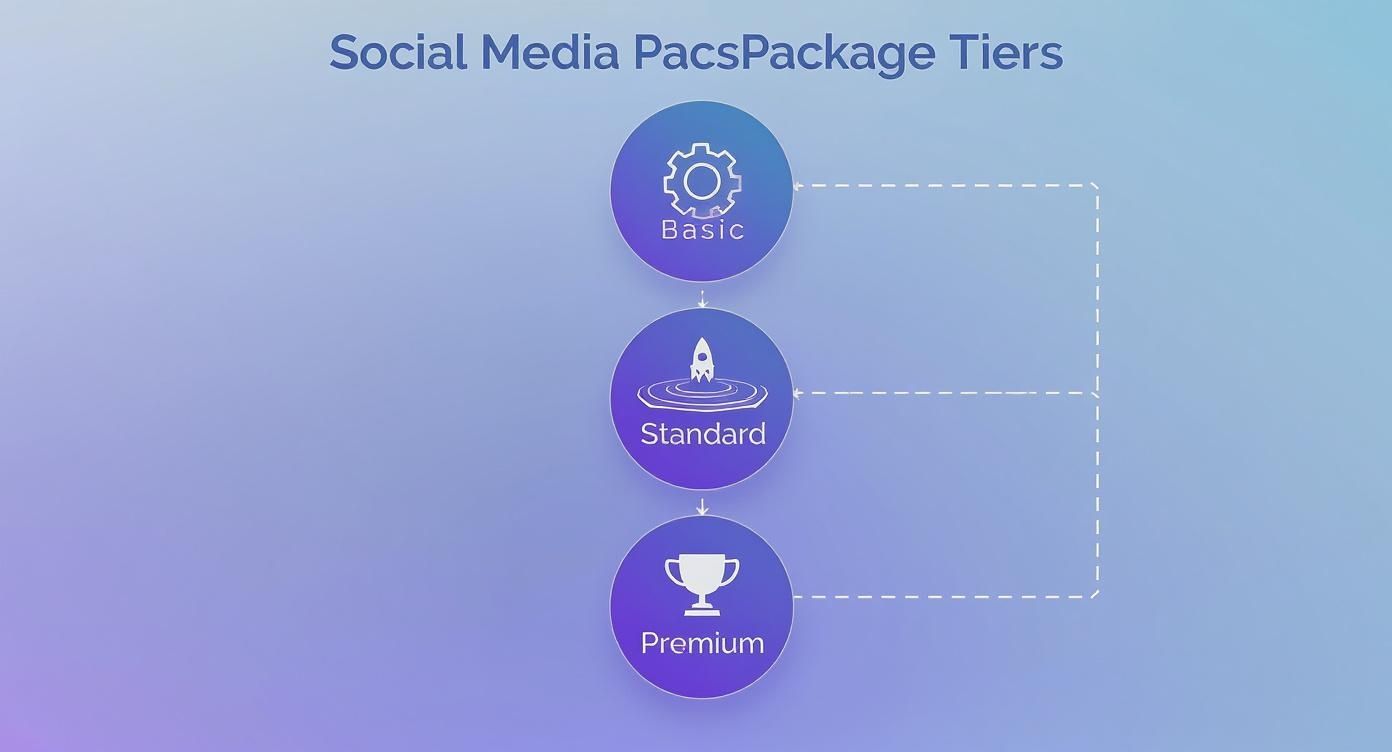
You can see a clear progression here, moving from foundational services in a Basic package to complex, multi-faceted strategies at the Premium level.
Paid Advertising and Content Creation Demands
Adding paid social ads to your package is one of the fastest ways to increase the price. Managing an ad budget is so much more than just clicking "boost" on a few posts. It's a discipline that involves campaign strategy, deep audience targeting, A/B testing creative and copy, and constant optimisation to make sure you aren't just lighting money on fire.
For context, small businesses often spend $650 to $2,500 a month on the ads themselves, plus another $500 to $2,500 for the management service. The platform you choose also matters a great deal. A click might cost $0.44 on Facebook, but that same click could be over $5 on LinkedIn, which dramatically changes the budget needed to see results. You can find more details on this in Sprout Social's comprehensive guide on social media costs.
Key Takeaway: Paid ad management is a specialized skill. The management fee—whether it’s a flat rate or a percentage of ad spend—covers the expertise required to turn your advertising dollars into a positive return.
Finally, high-end content creation will also push the price tag up. If your strategy depends on professional videography, custom animations, or influencer photoshoots, those production costs get rolled into your package. A plan that relies on stock photos and simple graphics will always be more budget-friendly than one that essentially includes a mini creative studio.
How To Choose The Right Package For Your Business
Staring at a page of social media management pricing packages can feel a bit like reading a restaurant menu in a foreign language. It's overwhelming. But picking the right one isn't about guesswork; it's about a clear, step-by-step approach.
Think of this as a serious business investment, not just another monthly expense. When you treat it that way, you start with your goals, not their price list. It’s a strategic decision that can pay off big time if you get it right.
Define Your Goals And Desired Outcomes
First things first: what are you actually trying to accomplish? Before you even glance at a proposal, you need to know what success looks like for you. Vague goals like "get more followers" won't cut it. You need to get specific.
Are you trying to blast into a new market and build brand awareness from scratch? Or is your main focus generating solid leads your sales team can actually close? Each of these goals demands a totally different strategy, and therefore, a different kind of package.
Brand Awareness: This is all about getting your name out there. You'll want a package heavy on content creation, frequent posting, and community engagement to maximise your reach.
Lead Generation: Here, the focus shifts to running targeted ad campaigns, crafting irresistible calls-to-action, and creating content specifically designed to get people to hand over their contact info.
Direct Sales: If you're running an e-commerce store, your package should be all about product-focused content, leveraging shopping features on platforms like Instagram, and running retargeting ads to reel in those on-the-fence buyers.
Nailing down your primary objective is the best filter you have. It instantly helps you weed out packages that just aren't designed to deliver what you need.
Audit Your Internal Resources And Skills
Next up, it’s time for an honest look in the mirror. What can you and your team realistically handle right now? Do you have a design wizard in-house? Or someone who actually has the time to jump on comments and DMs throughout the day?
Understanding what you’ve already got helps you pinpoint the exact gaps you need an agency or freelancer to fill. If you're a whiz with words but your visuals look like they were made in Microsoft Paint, you'll need a package that's strong on content creation. If your team creates killer content but the engagement ball gets dropped, you'll look for a partner focused on community management.
This audit keeps you from paying for services you can already handle just fine. To dive deeper into this, our guide on outsourcing social media management is a great resource.
A thorough internal audit ensures you’re not just buying a service, but solving a specific business problem. It’s the difference between hiring a helper and hiring a strategic partner.
This self-assessment is key. It makes sure you're investing in a package that plugs your weaknesses instead of just overlapping with your strengths.
Establish A Realistic Budget
Okay, you know your goals, and you know what you're missing. Now you can finally talk numbers. Most businesses put somewhere between 5% and 25% of their total marketing budget toward social media.
So, if you're spending $5,000 a month on marketing, a realistic social media budget would probably be in the $250 to $1,250 range. Use the pricing tiers we've talked about as a rough guide. A startup might get its feet wet with a basic package, while a growing business will likely need a standard package to really pick up speed. Your budget should feel like an informed decision, not a number you pulled out of thin air.
Ask The Right Questions Before Signing
When you finally start hopping on calls with potential partners, your best weapon is a sharp list of questions. Their answers will tell you everything you need to know about their process, their real-world expertise, and whether they're actually the right fit for you.
Don't be shy. Here are a few must-ask questions:
Process and Strategy: Can you walk me through your process for building a social media strategy from the ground up for a new client?
Industry Experience: Have you worked in my industry before? Can you show me a few case studies or results you're proud of?
Reporting and Metrics: What specific KPIs do you track to measure success, and can I see a sample report?
Content Ownership: If we ever decide to part ways, who gets to keep all the content you created? 5. Communication: Who's my day-to-day contact, and what does your communication rhythm look like?
Getting solid, confident answers here is the last piece of the puzzle. It ensures you’re signing up with a true partner, not just another vendor, and sets your investment up for success right from the start.
The Hidden Costs Of Tools And Technology
When you look at social media management pricing packages, it’s easy to think you're just paying for someone's time and creativity. But a big slice of that fee actually goes toward the powerful, professional-grade software that agencies and freelancers use behind the scenes. This tech stack is the real engine driving their efficiency and results.
These aren’t your everyday, free phone apps. We’re talking about enterprise-level platforms for scheduling, deep analytics, social listening, and content creation. It's like the difference between a home kitchen and a professional chef's setup—sure, you can cook a good meal, but the pro has specialized equipment to deliver restaurant-quality dishes, consistently and at scale.
The Professional Tech Stack
The tools a social media manager uses directly shape the quality of the service you receive. A well-equipped pro can automate the tedious stuff, pull out surprisingly deep audience insights, and track campaign performance with a precision that’s just not possible with basic tools. This investment in technology is a major differentiator.
To really get a handle on social media management costs, you have to factor in the best social media management tools that make it all happen. These platforms are the secret ingredient that explains why a fully-equipped provider might charge more—and why they're often worth it.
You aren't just paying for labor; you're investing in access to a professional tech stack that would be prohibitively expensive for a single business to license on its own.
This access gives your brand a huge strategic advantage. For a closer look at what separates these platforms, our guide on the best social media management platforms breaks down the key differences.
How Software Costs Influence Pricing
The social media software market is all over the map when it comes to price. For instance, Zoho Social has plans that top out at $40/month, while solid mid-range tools like Agorapulse run between $79 - $149 monthly.
Then you have the premium platforms. Hootsuite starts at $99, and a tool like Sprout Social can cost anywhere from $199 to $399 per month, per user. You can find more details about this pricing stratification on TrustRadius.
When an agency bundles these costs into their packages, they’re giving you access to a suite of tools that could easily cost your business thousands of dollars per year. Understanding this helps clarify the real value packed into their pricing, showing that you’re paying for powerful results, not just hours on the clock.
Your Top Pricing Questions, Answered
Diving into the world of social media management, pricing packages can feel a bit murky. Let's clear the air and tackle some of the most common questions that pop up, so you can feel confident in your next move.
How Much Should a Small Business Actually Budget?
For a small business just getting its feet wet, a realistic budget usually lands somewhere between $500 and $2,500 a month. Don't let that range scare you; what you get changes dramatically from one end to the other.
At the lower end, think $500 to $800. This is your foundation. It typically covers the essentials—keeping the lights on with consistent posts on one or two platforms and some light community monitoring. It’s all about maintaining a brand.
Once you start pushing into the $1,200 to $2,500 range, you're shifting from maintenance to active growth. This is where you get custom content, proactive community engagement, and deeper analytics that actually guide your strategy. The real question is, what's your goal? A simple brand identity, or a machine that generates leads? Your budget should reflect that.
How to Spot a Bad Proposal
Listen, not all proposals are created equal. If a provider starts making promises that sound too good to be true, they almost always are. Run, don't walk.
Here are a few major red flags to watch out for:
"We Guarantee You'll Go Viral." No one, and I mean no one, can promise virality. Real social media growth is a slow burn, built on a consistent and smart strategy, not a lucky lightning strike.
Vague, Fluffy Language. A proposal should spell out exactly what you're getting. If you see fuzzy terms like "brand boosting" or "increasing engagement" without any specifics, push back. Ask exactly what tasks that included.
Hiding the Numbers. Transparency is everything. Any agency or freelancer worth their salt will give you full access to your analytics and provide reports that make sense. If they're cagey about the data, it's a bad sign.
A solid proposal feels less like a sales pitch and more like a battle plan. It's built on measurable goals and a clear process, not empty hype.
Is It Okay to Negotiate a Social Media Package?
Absolutely. But smart negotiation isn't about just asking for a lower price. The best way to find a number that works for you is to have an open conversation about the scope of work.
If a quote comes in higher than your budget allows, talk to the provider about what can be trimmed back. Maybe you can start with two platforms instead of four. Or perhaps you can scale back from daily posts to three high-quality ones per week.
This approach lets you hit a comfortable price point without sacrificing the quality of the work. A true partner will be happy to work with you to build a custom package that fits your budget and still delivers real, tangible value.
Ready to stop guessing and start growing? Gainsty uses a blend of expert strategy and advanced AI to attract real, engaged followers to your Instagram profile. Grow your audience organically and watch your engagement soar.
.png&w=1920&q=75&dpl=dpl_34ZXCf12K5qjjdZjPn9snwDRADrB)




.png&w=750&q=75&dpl=dpl_34ZXCf12K5qjjdZjPn9snwDRADrB)