Why Small Businesses Hire Social Media Agencies Now
An agency earns its fee when social already drives demand but you can't plan, produce, reply, test and track consistently week after week. Running several platforms at once multiplies formats, comment threads and reporting even when each post looks simple, and a month of skipped work usually costs more than the posts themselves.
The upside justifies the system. According to Verizon's State of Small Business Survey of 600 SMB decision-makers, 76% of U.S. small and midsize businesses said social media positively impacted their business performance in 2025. That doesn't prove any retainer pays back. It proves the channel deserves a system, and systems need hours most owners don't have.
A good agency works like a part-time marketing department billed monthly. A bad one is a scheduling app with a sales pitch.
A full agency scope covers strategy, content production, community management, paid social and reporting. Owners who want to judge that scope more sharply sometimes build baseline literacy first, for example through a London School of Business Administration marketing course, then return to quotes with sharper questions.
Judge any candidate on two things: whether its work shows up in inquiries, and how much of your week it gives back. Follower counts and posting volume answer neither question.
You may not need one yet. A single-location business on one platform, an owner who enjoys creating content, and a budget of a few hundred dollars a month all point to advice or tools, not a retainer.
Agency Pricing Models and What Each Monthly Fee Covers
Start with price, because vague scope hides behind vague fees. These ranges are typical market estimates for 2026, so confirm every deliverable in a written quote.
Typical Monthly Agency Costs by Model
A solo freelancer typically charges $300-$1,000 per month for 8-12 posts, captions, scheduling and basic graphics. This suits a business with one platform and a low posting volume.
A boutique agency typically costs $1,000-$2,500 per month. That usually covers monthly strategy, 12-20 posts, community replies, and a monthly report, making it a fit for local businesses using one or two platforms.
A full-service agency generally charges $2,500-$5,000 or more per month for multi-platform strategy, video, paid social, influencer outreach, and KPI reporting. It suits growing or multi-location brands.
An audit or setup project is usually a one-time $500-$3,000 expense. It can cover an account audit, tracking setup, and a 90-day plan for an owner who will manage posting in-house.
Paid ads management typically starts at a flat $500 per month or 10-20% of ad spend. It covers campaign builds, testing, audience work, and weekly optimization for businesses with a proven offer and an ad budget.
Ad spend sits outside the management fee. So do influencer payment, product shipping, premium video production, and sometimes photography. Get those lines separated before you compare totals, a point also worth checking against structured social media packages and pricing breakdowns.
What Moves a Quote Up or Down
Platform count matters, but format matters more. Twelve static posts cost less than twelve posts where half need filming, editing, captions, and trend-aware hooks. Community management adds daily labor. Paid social adds audience building, creative testing, and landing page feedback. Deeper reporting adds analyst time, especially if someone has to reconcile leads in your CRM.
Content planning and creation: Calendar, copy, graphics, short-form video, and revisions.
Publishing and community management: Scheduling, comment replies, direct message triage and escalation rules.
Paid social and outreach: Campaign setup, audience tests, influencer sourcing and follow-up.
Strategy and reporting: Monthly calls, dashboards, lead counts and next actions.
Say a bakery runs one Instagram account with twelve posts a month, owner-shot photos and no ads. That fits a freelancer or boutique tier if the owner approves quickly. Say a three-location gym needs Meta ads, TikTok video, offer tests, and lead tracking by location. That's full-service work, and a cheap quote usually means someone cut strategy, editing, or measurement.
Contract length changes risk. Month-to-month costs more per month but lets you exit after a weak test. Six or twelve-month commitments should buy a lower fee, clearer deliverables, or included setup, not just lock you in. Setup fees can be fair for audits, tracking, and templates, but ask what asset you keep if you leave in month two.
I would treat the cheapest tier with suspicion when it promises volume without a named strategist, revision limit, or KPI report. Publishing alone rarely fixes a weak offer, slow landing page, or unanswered inbox. You're not buying posts. You're buying a repeatable path from content to inquiry, and the fee should show where that work happens.
Choosing Between an Agency and an AI Growth Platform
The bottleneck decides. An agency supplies people, strategy, and accountability. An AI-assisted growth platform supplies targeting, managed outreach, and software while you keep more control. Don't buy hands when your problem is direction, and don't buy software when your problem is that nobody has time to film, edit, reply, and report.
Agency or AI Growth Platform by Situation
If you can film and post but lack a plan, consider an AI-assisted growth platform or a one-time audit. You need direction and tools more than extra hands.
If you need content, ads, and reporting every month, a boutique or full-service agency is a better fit. Production capacity and accountability are the bottlenecks.
If your main goal is Instagram follower growth and you can review results weekly, an AI-assisted growth platform such as Gainsty may fit. You set targeting in the software, the team handles organic outreach manually, and you keep control of the account.
If you need revenue attribution tied to your CRM and sales, choose an agency with CRM-integrated reporting. Platforms rarely own the full sales pipeline.
If your monthly budget is under $300, consider a freelancer or do it yourself with a quarterly audit. Agency retainers at that price rarely include strategy.
What a Platform Does Well, and Where It Stops
Gainsty's setup follows three steps: connect your Instagram account, set targets based on competitors, age, location, gender, and language, then watch the account grow organically. The service includes a free trial, a manual profile review covering your profile, content, engagements, comments, competitors, and niche, and access to an Instagram specialist by chat or a call booked over email. A free Instagram analysis tool lets you check an account first, since it needs only a public username and no login.
That's useful when your content is decent, but discovery is weak. You still own posting, offers, direct message follow-up, and sales. If scheduling is part of the friction, compare workflows in roundups of social media scheduling tools for small teams before you add another retainer.
The trade-off is speed. One reviewer, Johannes B., put it this way:
"Growth is a bit slow compared to running ads, honestly, but the follower quality is high. People actually engage and book calls, and retention is solid over several months."
Read that as a trade-off, not a flaw. Paid ads buy traffic faster when your offer and landing page already convert. Organic growth compounds more slowly and depends on profile clarity, content relevance, and how fast you follow up. Neither option repairs a confusing service page.
Choose an agency when you need someone accountable for monthly production, paid campaigns, and revenue reporting. Choose a platform when you can create, you review results weekly, and targeted Instagram growth is the specific missing piece. Choose an audit when you're unsure, because a 90-day plan with tracking often reveals whether the constraint is content, audience, offer, or follow-up.
KPIs That Prove an Agency Is Working
Follower growth is not a result. It's an input that may or may not become money. The chain runs reach, engagement, clicks, leads, customers, and your agency should report where people drop out, not just celebrate the top.
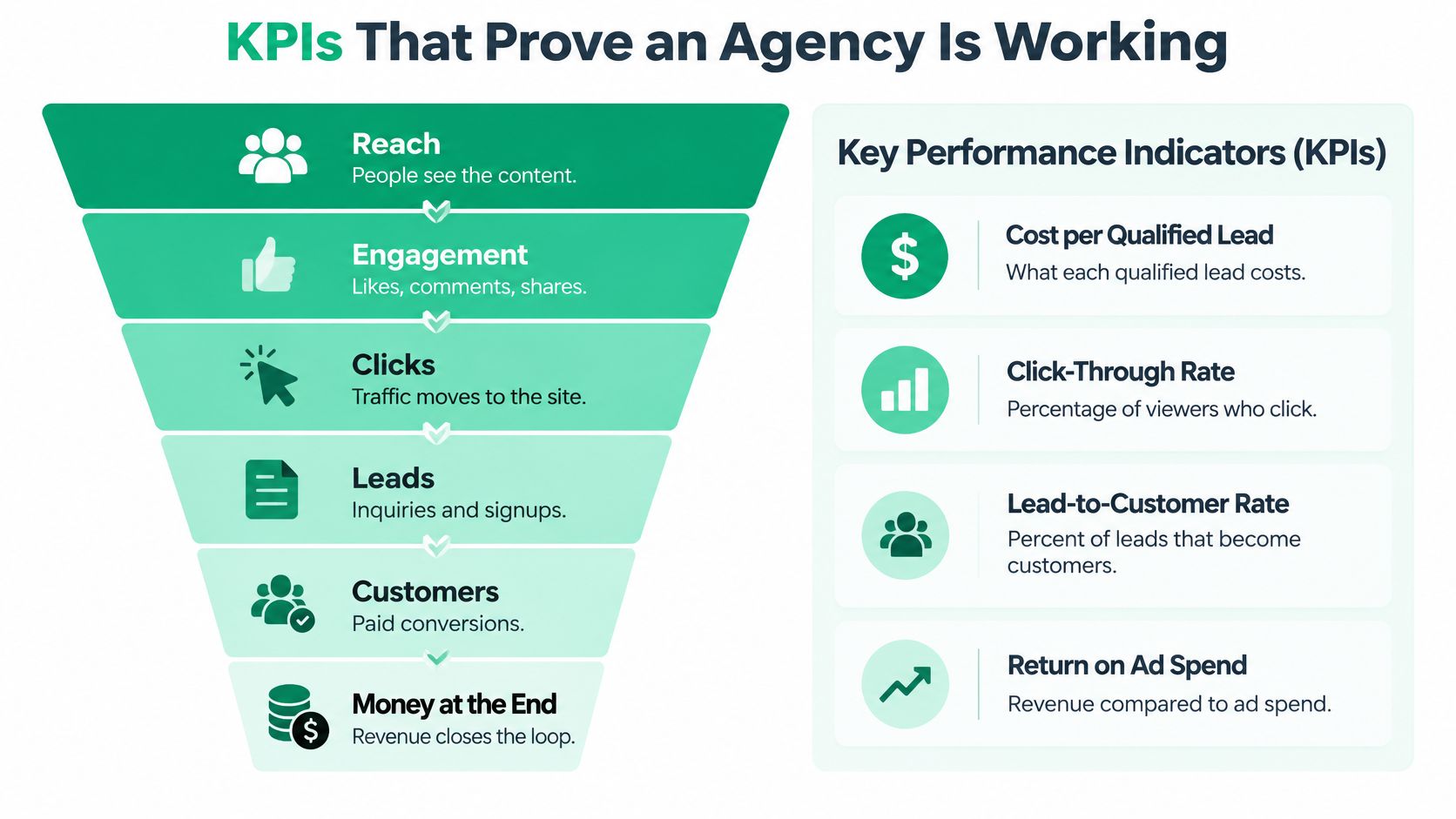
KPIs an Agency Should Report, With Reference Points
Cost per qualified lead divides spend by the number of leads that meet your criteria. Establish a baseline in your first controlled test, and watch out for cheap leads that never close.
Click-through rate for Facebook traffic campaigns shows whether an ad earns a click. WordStream reported a 2025 average of 1.71%. If clicks are strong but sales are weak, check for a landing-page mismatch.
Lead conversion rate for lead campaigns shows whether the post-click experience produces a lead. The reported average was 7.72%, compared with 18.25% for restaurants and food, 10.53% for legal services and 10.05% for education. Don't compare results across industries without context.
Assisted conversions count sales where social media touched a buyer before another channel closed the deal. Track them monthly beside direct conversions so last-click reports don't hide social's contribution.
Follower-to-customer rate is the share of followers who inquire, book or buy. Set your own 90-day baseline, and question follower growth that has no revenue link.
Engagement rate measures interactions relative to reach. Track its trend against your own baseline, but don't treat engagement alone as proof of revenue.
Use benchmarks as diagnostics, not targets carved in stone. WordStream's 2025 benchmark analysis covered more than 1,000 campaigns and reported an average Facebook traffic-campaign click-through rate of 1.71% and an average lead-campaign conversion rate of 7.72%. The same analysis reported lead conversion rates of 18.25% for restaurants and food, 10.53% for legal services and 10.05% for education, so cross-industry bragging is meaningless.
How to Diagnose a Weak Month
Work in order. First, compare CTR by audience and placement. Then check landing-page view rate, form starts, completions, qualified-lead rate, and cost per qualified lead. A high CTR with a weak lead rate usually points to message mismatch, unclear offer, slow page or form friction, not poor creative. Fix the page before you fire the ad maker.
For paid campaigns, pair lead cost with downstream value. Dekodi's guide to advertising returns is useful background when you need return on ad spend explained beside lead metrics, and a structured social media ROI measurement framework helps keep assisted conversions visible instead of forcing every sale into last-click credit.
Your minimum monthly report should include tagged links on every social URL, leads by source, qualified leads, cost per qualified lead, assisted conversions where available, and one decision the data supports. That decision might be shifting budget to the creative with a higher qualified-lead rate, cutting an audience that clicks but never books, or rewriting a landing page headline.
Practical rule: If engagement rises while sales-qualified leads stay flat, you're attracting attention from people who don't intend to buy.
Set separate baselines for prospecting and retargeting. Retargeting should convert better because those users already know you. Mixing both hides whether new demand is growing.
Red Flags and Questions to Ask Before You Sign
Guaranteed follower counts or viral results are the fastest stop sign. No honest agency controls platform distribution or buyer intent.

Watch for these patterns in proposals and sales calls.
Bought growth: Follower buying, bots, or follow-unfollow tactics.
No written scope: Deliverables, revisions, and response times stay vague.
Vanity reporting: Likes and follower totals with no lead source.
Access hostage: Refusal to give you admin access to your own accounts.
Lock-in pressure: Long contract, no exit clause, no trial or audit path.
Missing operator: Sales lead never introduces your account manager.
Attribution deserves direct pressure. According to HubSpot's social media marketing report, only 37% of marketers say it is easy to tie social activity to business outcomes. Ask how posts tie to leads in a CRM or spreadsheet, how assisted conversions get recorded, and how cost per qualified lead appears monthly. For a small budget, a simple lead log beats expensive attribution software nobody maintains.
Use these question groups on the call, and borrow wording from social media manager interview questions when you need sharper follow-ups.
Production: Who writes and edits, how many revisions, how fast must approvals return?
Ownership: Who owns assets, passwords, raw files, and audience data?
Measurement: How is cost per qualified lead calculated and how often?
Continuity: What happens in a paused month, and can you speak to two similar-size clients?
A vague answer on ownership or reporting is a stop sign, even if the creative portfolio looks strong.
How to Onboard an Agency in the First 90 Days
Onboarding fails when goals, tracking, and approvals drift. Lock those three before volume increases.
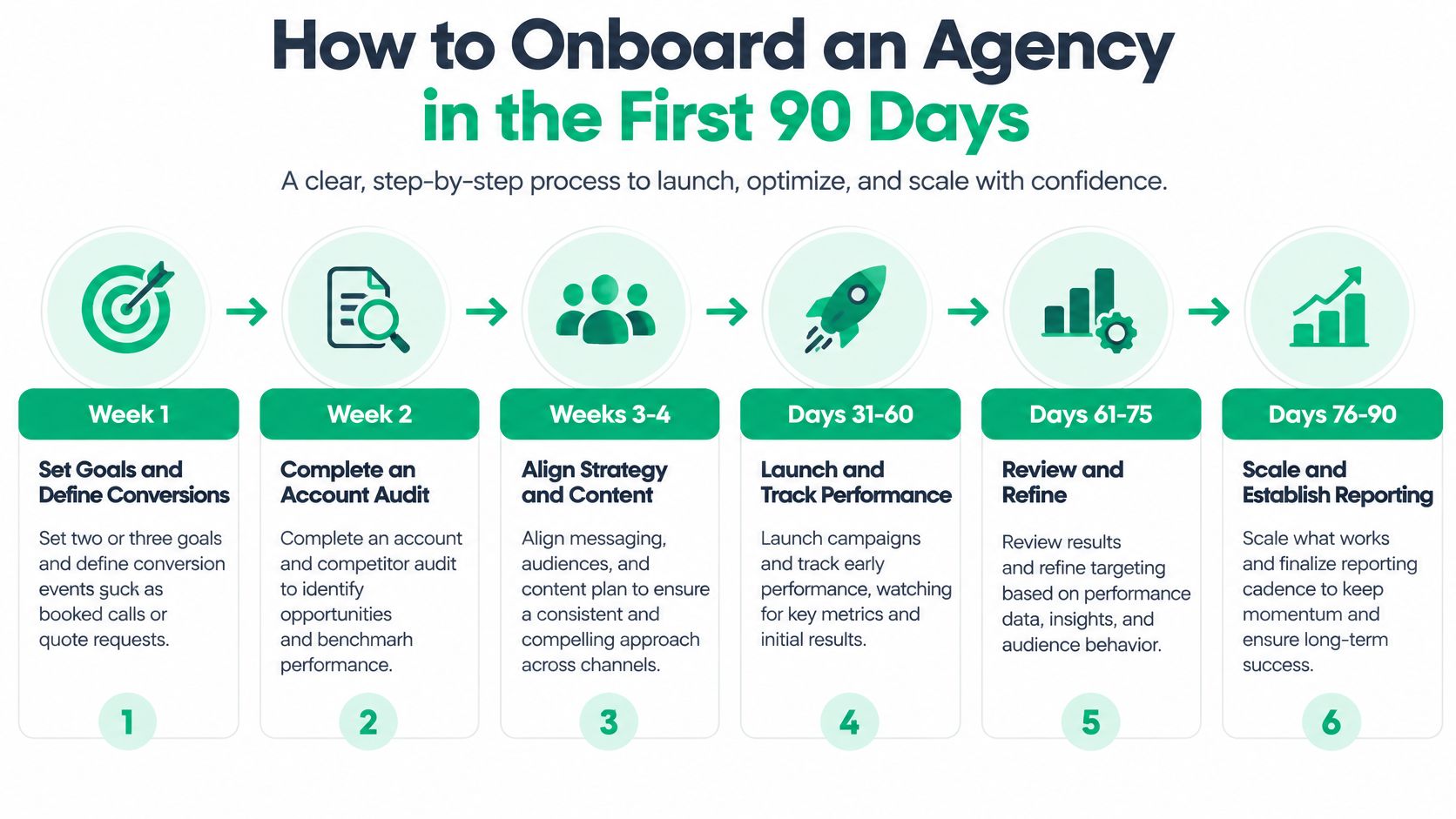
Six Stages With Owner Inputs
Week 1, goals and conversion events: The agency drafts two or three goals tied to booked calls, quote requests, orders or qualified inquiries. You confirm what counts as qualified, average order or job value, service area, and offers you won't discount.
Week 2, audit and ownership: The agency audits accounts, top posts, competitors, profile links and inbox handling. You supply admin access, brand files, customer questions, and proof points, and both sides confirm who owns accounts, raw assets, and ad accounts.
Weeks 3-4, tracking and content system: The agency adds UTM tags to every social link, connects forms or booking tools to your CRM or spreadsheet, and builds content pillars. You supply photos, service details, testimonials, and approvals within 48 hours so production doesn't stall.
That approval point matters because capacity is tight. In Verizon's State of Small Business Survey, as reported by Marketing Dive, 54% of SMBs reported struggling to keep content fresh and stay current with social media trends in 2025. A clear approval deadline protects freshness without turning every post into a meeting.
Weeks 5-6, controlled first test: Run a fixed budget split between two audiences or two creatives, with one primary conversion event. The agency handles setup, tagging, and daily checks. You handle lead response speed and mark lead quality accurately, because unmarked junk leads teach the wrong lesson.
Month 2, benchmark and cut: Compare CTR, lead rate, qualified-lead rate, and cost per qualified lead against your baseline, not a generic chart. Keep what produces qualified demand, rewrite weak landing pages, and cut content themes that earn comments but no inquiries.
Month 3, cadence and report lock: Finalize publishing days, approval windows, escalation rules for direct messages and the monthly report format. The report should end with decisions, budget shifts, and next tests, not screenshots alone.
By month three, aim for 2-3 hours a week of owner time. That's a 30-minute weekly call, about 30 minutes of approvals, regular lead-quality marking inside your normal sales work, and one monthly report review. If you're still rewriting captions daily in month three, the agency hasn't built a system, or you haven't delegated enough authority for one to work.
Confirm Your Shortlist Before You Sign
Score finalists on the same evidence, including a platform option if Instagram growth is part of the decision.
List two or three options: Include at least one agency and, where relevant, an AI-assisted growth platform.
Score each from 1 to 5: Rate price per deliverable, KPI reporting, quality of red-flag answers, onboarding plan, and exit terms.
Demand a sample monthly report: It should show cost per qualified lead, tagged-link sources, qualified versus raw leads, and decisions taken.
Run a paid audit or 30-day trial first: Ask any platform for setup steps, trial terms, and reporting in writing. We offer a free Instagram analysis tool that requires only a public Instagram username and no login, which makes an easy pre-check.
Sign for 90 days: Put scope, asset ownership, admin access, approval deadlines, and an exit clause in writing.
Set day 60 and day 90 reviews: Agree which metrics trigger budget shifts, creative changes, or termination.
Don't let a polished portfolio override a weak measurement plan. Creative quality matters, but you need to know whether that creative produces qualified demand at a cost your margins can carry.
Walk away if there's no agreed measurement of revenue-linked results.
If your bottleneck is targeted Instagram growth rather than full monthly production, Gainsty gives you a three-step setup, a free trial, and a manual profile review before you commit to a larger plan. Bring the same shortlist scorecard, check how follower quality turns into engagement and inquiries, and choose the option that protects both revenue and your time.