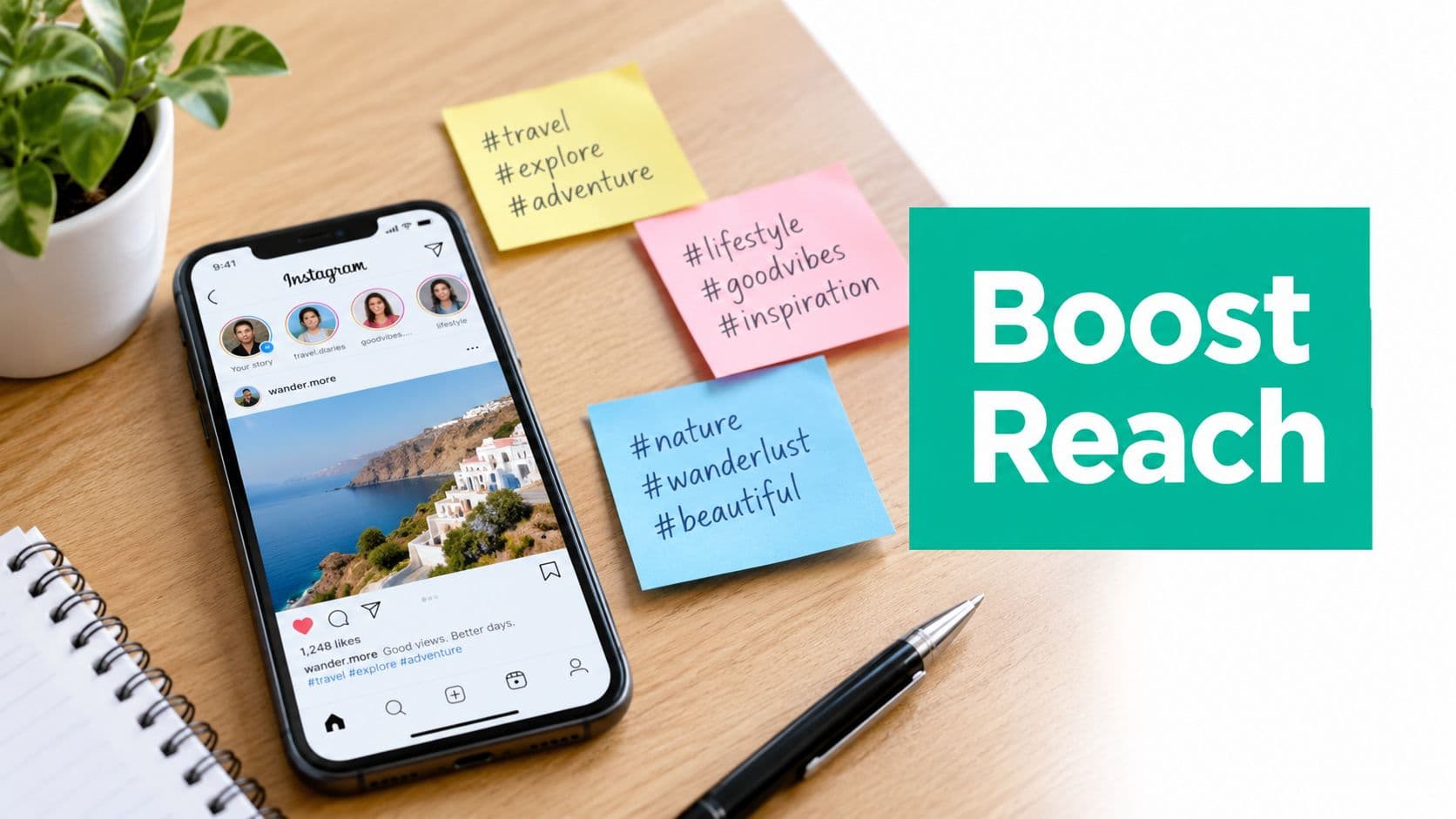
1. Niche-Specific Community Hashtags
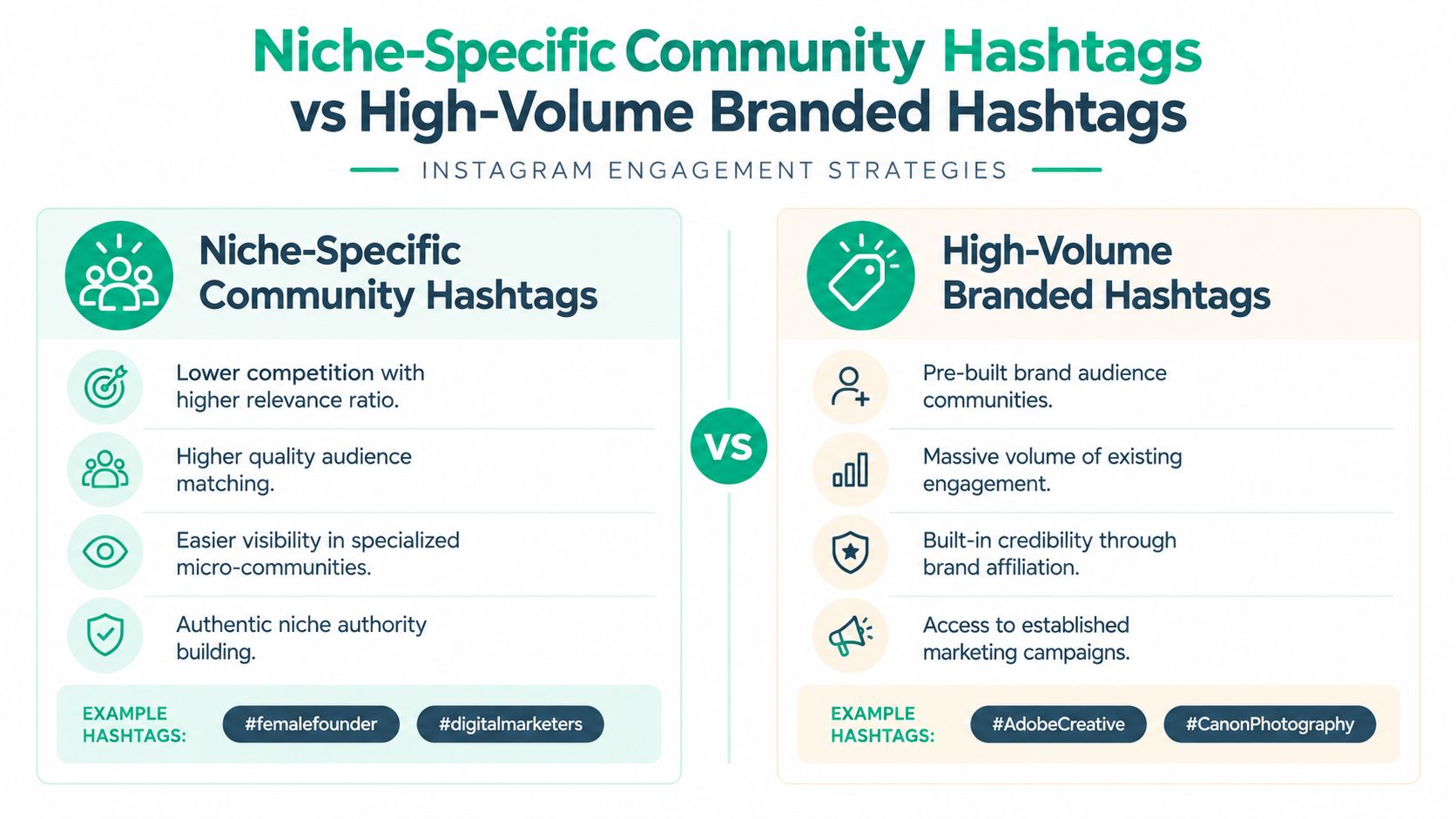
Niche-specific hashtags help your post enter a focused conversation. Instead of competing for attention around a broad topic such as #business or #fitness, you can describe the exact community you want to reach with tags such as #femalefounder, #vegancommunity, #sustainablefashion, or #travelblogger.
These tags are useful because they connect your content with people who already understand its subject. A vegan recipe creator, for example, might use #vegancommunity alongside a post-specific tag such as #plantbasedbreakfast. A creator discussing workplace wellbeing might choose #mentalhealth and add a narrower tag that reflects the audience or issue in the post.
Match the tag to the conversation
Research the hashtags your audience uses. Look at relevant creators, professional accounts, customer posts, and community discussions. Pay attention to whether the content under a tag resembles your own post. If most posts are product promotions and you're sharing an educational discussion, the tag may not attract the right response.
Try building each post around a small core of community tags:
Audience tag: Identify the people, such as #contentcreators or #cryptotraders.
Topic tag: Describe the subject, such as #fitnessmotivation or #mentalhealth.
Context tag: Add the specific use case, format, or problem addressed in the post.
Practical rule: A niche tag should help a relevant person recognize the post as useful before they interact with it.
Don't assume the same niche set will work forever. Communities change, terminology evolves, and different tags may attract different levels of conversation. Review which groups bring thoughtful comments, saves, profile visits, and relevant followers. Gainsty's analytics can be used as an optional way to compare those patterns, while competitor and community observation can provide important context.
Include niche tags in educational posts, practical tutorials, behind-the-scenes content, and opinion-led discussions. They support organic discovery best when the post gives that community a clear reason to stop scrolling.

2. High-Volume Branded Hashtags
High-volume branded hashtags give a post a recognizable identity. They can connect content with a company, product, campaign, event, or creator, as seen with #AdobeCreative, #CanonPhotography, #AppleCreators, #FigmaDesign, and #SpotifyArtist. A campaign team may also create a new tag for a launch or customer-content initiative.
The tag works like a filing label. It groups related posts so interested people can find the wider campaign, while the rest of the hashtag set explains the individual post. A photographer might combine a camera brand tag with a portrait tag. A software company could pair a campaign tag with a design topic that tells viewers what they will learn or see.
Give the brand a job, then add context
Branded hashtags support recognition and authority. They rarely provide enough context alone, especially when a post uses several company-related tags. Someone may identify the account behind the content without understanding why the post deserves attention.
Build the set around the post's purpose:
Brand identity links the content to the company or creator.
Product or campaign context identifies the relevant feature, launch, event, or initiative.
Audience relevance helps people interested in that subject recognize the post as useful.
For example, a product tutorial can use the brand tag, the feature or campaign tag, and a professional topic tag. A customer story can use the campaign tag with a product and use-case tag. This combination supports discovery while making user-generated content easier to group.
Monitor the conversation under branded hashtags after publishing. Answer customer questions, acknowledge useful contributions, and ask permission before resharing another person's work. Collaborators should use a brand tag only when the content directly relates to it. An unrelated famous name can attract the wrong audience and weaken trust.
An original hashtag may take time to become familiar for a small creator. Use it as an organizing label, while niche or professional tags explain the post's subject and audience. Treat each set as specific to the post, rather than copying the same branded collection everywhere.
3. Trending and Viral Hashtags
A trending hashtag can place timely content inside an active conversation, but it is not a substitute for relevance. Trends may come from a cultural moment, challenge, current event, seasonal topic, or format such as #Reels or #Challenge. Their usefulness fades, so the right moment and a clear connection to the post matter more than a long collection of popular tags.
A food creator could join a recipe challenge with a recipe that aligns with its theme. A design educator might respond to a current creative trend through a tutorial. A travel account could enter a destination conversation when the post shows or explains that place. In each case, the trend supports discovery while the content supplies the reason to watch, comment, or follow.
Use trending tags for a specific job: timely discovery. Pair that job with tags that provide relevance and community fit. A topic tag tells people what the post covers, while a community tag helps it reach people who already care about that subject. The set works like a signpost system. One sign points to the current conversation, another identifies the subject, and the third directs the post toward a suitable audience.
Broad tags such as #Viral, #Trending, or #FYP rarely explain why a post belongs in a conversation. Adding them to every upload can attract viewers with no interest in the account, producing weak engagement and little lasting recognition.
Research possible trends with Gainsty's guide to finding trending Instagram hashtags, then inspect the posts using each tag before publishing. Check whether the conversation still matches your subject. If the tag has shifted toward another topic, leave it out.
Let the creative idea lead. Record which timely topics bring relevant profile visits or genuine conversation, and retire stale trends. Smaller, interested attention can serve the account better than brief visibility from people who move on immediately.
4. Engagement-Bait and Call-to-Action Hashtags
Call-to-action hashtags can label the kind of participation a post invites, but they do not create a reason to respond by themselves. Examples include #CommentBelow, #SaveThis, #ShareThis, #TagSomeone, #WouldYouRather, and #FillInTheBlank. Treat them as participation signals, not interchangeable reach boosters.
Match the hashtag to the post's job. A post comparing two packaging designs can use #WouldYouRather because it gives people a clear choice. A tutorial containing a useful reference list may suit #SaveThis. A discussion of a common professional problem can use #CommentBelow when the caption asks a focused, open question.
The caption must carry the invitation. Ask readers to describe an experience, choose between options, explain a preference, or add a missing idea. A generic request for engagement gives people little to say and can make the account appear focused on activity rather than conversation.
Use the following matches as a practical guide:
Comment invitation: Ask for an experience, preference, or answer that relates directly to the topic.
Save invitation: Point to a guide, process, checklist, or reference people may need again.
Share invitation: Offer information that a viewer's colleague or friend would find useful.
Tag invitation: Include it only when another person's perspective genuinely belongs in the discussion.
Relevant hashtags may support discovery. Instagram hashtag benchmarks found that posts with at least one hashtag averaged 4.2% higher engagement than posts without hashtags, while posts using 11 or more hashtags received 16% more interactions than posts using fewer than five in the cited dataset. The same source reported that 61% of Instagram users use hashtags to discover new content. These figures do not show that a call-to-action hashtag causes engagement. They indicate that relevant hashtags can help people find a post that already earns attention. The benchmark and its methodology are available here.
Choose one primary action instead of stacking several commands. Review the quality of comments, saves, shares, and follow-up conversations, then check ways to remove fake followers safely if audience activity may not reflect genuine interest.
5. Seasonal and Holiday Hashtags
A seasonal hashtag adds timing, not automatic relevance. Tags such as #NewYearNewMe, #BackToSchool, #FallVibes, #HolidaySeason, #BlackFriday, and #SpringAwaits work best when the post addresses a need, mood, event, or buying moment that matters during that period.
A fitness coach could share a realistic winter training guide. A retailer might offer gift-selection advice, while a food creator publishes holiday preparation content. A consultant could explain planning priorities at the beginning or end of a business cycle. In each example, the hashtag supports discovery by clarifying when the content is useful. The topic and audience fit still do the main work.
Give the seasonal tag one clear job
Use seasonal hashtags as a layer over evergreen relevance. A holiday meal-planning post might combine a seasonal tag for timing, a food-community tag for discovery, and a recipe or dietary tag for precision. Together, they explain when the post matters, who may want it, and what it contains.
Build each set around the post:
Relevance: Start with the audience need during the season, such as planning, preparation, training, or gift selection.
Discovery: Add an event or seasonal tag that accurately describes the occasion.
Community: Keep a niche or topic tag that connects the post with the right viewers.
Participation: Use a prompt only when the content genuinely invites people to share a routine, preference, or experience.
Refresh the caption as well. Explain why the advice is useful now, because a hashtag cannot supply context that the post does not provide.
Timing affects both production and publication. Prepare the content early enough to review its wording, visuals, offer details, and community relevance. Publish while the subject remains meaningful, rather than attaching a seasonal tag after public attention has moved on.
Seasonal posts can support promotions, but they can also teach or document. A local business might share preparation advice, a creator could record a personal routine, or an educator may explain an event's history or practical meaning. Choose tags that describe the post accurately instead of using them to pressure a response.
6. Location-Based and Geographic Hashtags
A location hashtag does not make unrelated content locally valuable. It works best when the post concerns a city, region, neighborhood, landmark, or local culture. Examples include #LosAngeles, #NYCInfluencer, #LondonLifestyle, #BayAreaTech, #AustinCreatives, and #ChicagoInfluencers.
Restaurants, shops, property professionals, event organizers, travel creators, photographers, and regional service providers can use these tags to reach people with a geographic connection. For example, a local interior designer could combine a city tag with an accurate neighborhood tag and a design-community tag. A digital consultant might use regional tags when discussing local clients, regulations, events, or business conditions.
A city tag provides broad relevance. A neighborhood tag acts like a more precise address. Use both only when the content applies to both places. A restaurant should name its actual area rather than choosing a more popular nearby neighborhood.
Build the set around the post's job:
Local offer: State where customers can access the product or service, then identify the relevant city or area.
Community story: Highlight a local event, partner, customer, or shared concern.
Travel content: Name the destination and the specific experience, such as a landmark visit or neighborhood activity.
Professional service: Identify the region where the advice, regulations, or service applies.
Read this guide to geotags on Instagram, then compare hashtag activity with the location feature attached to the post. These signals support different kinds of context. A location hashtag labels the topic in the caption or comment, while a post location gives Instagram and viewers additional place information.
Local discovery also depends on participation. Follow relevant tags, comment on nearby creators' posts, and watch for events that fit your work. Choose geographic hashtags for accuracy first, then add broader discovery or community tags when the post supports them. The content still needs useful information, atmosphere, practical value, or a real connection to the local community.
7. Educational and Thought Leadership Hashtags
Educational hashtags give a post a subject, while the lesson gives people a reason to stop, learn, and respond. Useful examples include #DigitalMarketing, #CareerAdvice, #Entrepreneurship, #BusinessTips, #LeadershipDevelopment, #MarketingStrategy, and #TechEducation.
Choose the tag for the job it performs. A subject tag supports relevance and discovery. An audience tag helps the right learners recognize the post. A format or outcome tag signals whether they will find a tutorial, framework, career idea, or practical tip. These labels guide discovery, but they cannot replace clear teaching.
A marketing consultant might explain how to interpret a content report. A software developer could break down a technical concept. A career coach might show how to improve a portfolio. In each case, the hashtag identifies the field, while the explanation earns attention, saves, shares, and questions.

Make authority practical
Thought-leadership tags fit a specific idea, not a vague motivational message. Explain the problem, show the reasoning, and give readers a step they can apply. Support factual claims with credible evidence in the caption or direct readers to a detailed resource.
Build each hashtag set around the post:
Subject tag: Name the discipline, such as #DigitalMarketing.
Audience tag: Identify who benefits, such as #SmallBusiness.
Format or outcome tag: Describe the lesson, framework, or professional goal.
Recurring educational themes can make your expertise easier to recognize. An SEO consultant might cover keyword research, content briefs, technical checks, and measurement. The related tags can stay consistent while the wording and lesson change for each post.
These hashtags may attract learners, peers, potential clients, and future collaborators. Evaluate the quality of those interactions, not reach alone. Saves, shares, thoughtful questions, and profile visits can show that a lesson helped, even when visible response remains modest.
8. Niche Micro-Influencer and Collaboration Hashtags
Collaboration hashtags do more than increase visibility. They help smaller creators identify relevant peers and signal that a partnership may be welcome. Examples include #MicroInfluencer, #CreatorCommunity, #SupportSmallCreators, #InfluencerNetwork, #CreatorEconomy, #SmallBusiness, and #CreatorCollaboration.
Choose the tag for the job it performs. A community tag supports discovery among creators, while a niche or business tag clarifies relevance. A food photographer might use a creator-community hashtag while seeking a recipe developer. A local clothing designer could reach a stylist, model, or small retailer. A software educator might find another specialist with complementary expertise.
The post itself should make the proposed fit easy to understand.
Make the partnership easy to assess
Treat a collaboration hashtag as an introduction, not a complete proposal. Your profile, recent posts, and caption should show what you create, who you serve, and what both audiences could gain.
Build the invitation around four details: Show your contribution by naming the skill, product, access, or perspective you bring. Name the fit by identifying the creator or business that complements your work. Suggest a format such as a joint live session, tutorial, interview, product feature, or community event. Invite a specific response by asking interested people to comment or message you with relevant details.
The best hashtag set combines a collaboration tag with the post's subject, audience, or location. That combination helps potential partners judge relevance instead of treating every creator tag as an interchangeable reach booster.
Review the content from people using these hashtags before contacting them. Add a useful comment, check for audience overlap, and look for compatible working styles. One post can start an introduction, while consistent interaction helps build trust.
Measure the relationship, not follower growth alone. Check audience relevance, profile visits, meaningful comments, direct messages, and continued participation after the first exchange.
9. Industry-Specific Professional Hashtags
A professional hashtag works like a label on a shop door. It tells Instagram and viewers what kind of work sits behind the post. Examples include #RealEstateAgent, #DigitalMarketer, #GraphicDesigner, #SoftwareDeveloper, #UXDesigner, #DataScientist, #SEOSpecialist, and #ContentMarketer.
These tags support relevance and discovery for service providers and B2B accounts because they describe the creator's role, not just the subject of one post. A UX designer might use #UXDesigner on a portfolio walkthrough. A real estate professional could pair #RealEstateAgent with a location tag and a topic such as home preparation or market education.
Let the post prove the label
A professional hashtag gains authority when the content demonstrates the skill it names. Show a process, analysis, before-and-after explanation, portfolio example, client education topic, or considered industry observation. Keep confidential client information private, and avoid performance claims that the post cannot support.
Build each set around the post's job. Start with a Role tag that states your professional identity. Add an Industry tag to connect with the wider field, then a Specialty tag that narrows the service or capability. Use an Audience tag for clients, employers, founders, or peers when that group is relevant.
Research language from professional organizations, publications, competitors, and clients. Practitioners may use technical terms, while potential customers may search for a plain-language problem. Match the set to the reader you want to reach.
These hashtags classify your content and create discovery opportunities. They do not replace a clear profile, strong examples, or useful captions. Check whether engagement comes from plausible clients, partners, employers, or professional peers, then adjust the set to improve relevance rather than just adding more tags.
10. User-Generated Content and Community Challenge Hashtags
User-generated content hashtags give followers a clear way to participate, while community challenge hashtags organize that participation around a shared prompt. Examples include #PhotographyChallenge, #WriteWithMe, #ArtChallenge, #DanceChallenge, #BeautyTutorial, #DIYChallenge, and #FitnessChallenge. Recurring tags such as #MondayMotivation and #TransformationTuesday can provide a familiar reason to return and contribute.
Treat these hashtags as participation tools, not interchangeable reach boosters. They make a post's purpose easier to understand, support discovery when entries use the same public tag, and create conversation when the account responds to contributors.
A stationery brand could ask customers to share a weekly planning spread. A fitness creator might invite followers to document a realistic exercise habit. A photography account could set a theme and feature selected submissions. Each idea gives people a specific action rather than asking them to post something vague.
Give people a simple way in
Explain what participants should create, which hashtag to use, whether the post must be public, and how contributions may be featured. If recognition or an incentive is offered, state the terms clearly. Participation should not imply guaranteed exposure.
Build the prompt around four practical details:
A narrow prompt: Give people one understandable creative direction.
A participation path: Tell them what to publish and how to label it.
A recognition plan: Explain how you may feature, comment on, or reshare entries.
An inclusive standard: Avoid requiring costly equipment, advanced skills, or unrealistic outcomes.
Reply to submissions and ask permission before resharing. Feature different kinds of participants, not only polished entries. That approach makes the activity feel like a community contribution rather than a contest for established creators.
For more ideas, see ideas for using user-generated content. The ShortGenius AI UGC ad platform can also support teams developing UGC advertising concepts. Use tools for planning, while keeping the prompt, moderation, and recognition human.
Instagram Engagement Hashtags, 10-Type Comparison
Niche-specific community hashtags usually require moderate research and occasional updates, but they are relatively light on resources and often attract high-quality followers with stronger engagement. They work especially well for organic growth and authority building because they offer high relevance, authentic audience fit, and easier visibility within a specific industry.
High-volume branded hashtags are simpler to implement because you mainly need to choose relevant brand tags or join active campaigns. They generally require little time unless a partnership is involved, and they can support broad reach with medium follower quality by tapping into brand recognition and established communities.
Trending and viral hashtags take more effort because they depend on real-time monitoring and quick publishing. They can deliver major short-term visibility, but the quality of that attention varies, so they are best for timely moments, trend participation, and fast-moving content opportunities.
Engagement-bait or call-to-action hashtags need moderate effort because the prompt, caption, and follow-up all matter. They do not require many resources, but they can increase comments, saves, and shares when used in a natural way that matches the post.
Seasonal and holiday hashtags also require moderate planning because timing matters. With a content calendar and well-timed publishing, they can create predictable spikes during relevant periods, which makes them useful for promotions, event tie-ins, and recurring seasonal campaigns.
Location-based and geographic hashtags are relatively easy to use as long as they are accurate. They require minimal resources, yet they can deliver strong local relevance and targeted geographic reach, which makes them valuable for local businesses, travel posts, and event-related content.
Educational and thought leadership hashtags require consistent expertise, research, and quality content production. They demand more effort than simple discovery tags, but they often attract credible, high-quality followers and support steady long-term growth for consultants, coaches, B2B brands, and professionals.
Niche micro-influencer and collaboration hashtags involve moderate effort because outreach and relationship building take time. When used well, they support partnership growth and mutual audience expansion, especially for creators and businesses looking for authentic cross-promotion.
Industry-specific professional hashtags also call for moderate research because the terminology needs to match both the field and the audience. They are especially useful for service providers, consultants, and B2B marketers because they strengthen credibility and help attract qualified professional attention.
User-generated content and challenge hashtags are usually the most demanding because they require planning, moderation, promotion, and sometimes incentives. In return, they can generate strong social proof, high engagement, and a large volume of community content, which makes them effective for UGC campaigns and shared participation initiatives.
Build Hashtag Sets Around the Post, Not the Follower Count
The strongest Instagram engagement hashtags are selected according to the post's job. A local offer needs a different set from an educational carousel, a creator collaboration, or a community challenge. Follower count can influence who sees and responds to content, but it shouldn't determine the meaning of every tag you use.
Start with one primary category. If your post teaches, lead with an educational or professional hashtag. If it promotes a local service, lead with a location tag. If it asks people to participate, lead with a challenge or user-generated content tag. This primary category should make the post's purpose clear before you add anything else.
Then add complementary tags that improve context:
Educational post: Pair a subject tag with a professional or audience tag.
Local offer: Combine a city or neighborhood tag with the service category.
Collaboration: Use a creator-community tag alongside the relevant niche.
Seasonal post: Add the event context while keeping the evergreen topic.
Community challenge: Use the challenge tag with the audience or activity category.
Branded campaign: Add the brand label only when the post genuinely belongs to it.
Reserve trending hashtags for posts that belong to the current conversation. Use branded tags when they create a useful connection to a company, campaign, or customer-content system. Add call-to-action hashtags only when the requested action fits the content. A small, relevant set is often easier to evaluate than a crowded collection of unrelated tags.
Testing should be systematic. Create separate sets for educational posts, local offers, collaborations, seasonal content, and community challenges. Change one meaningful variable at a time when possible, such as the primary category, the niche tag, or the location layer. Keep the caption and creative quality reasonably consistent so you can interpret the result.
Measure more than reach. Review the quality of comments, saves, shares, direct messages, profile visits, and new followers. A hashtag set that reaches fewer people but brings relevant followers and useful conversations may be more valuable than one that produces broad, low-intent visibility. Historical research supports this need for segmentation. One analysis found different hashtag patterns for accounts of different sizes, while another found that performance varied by niche and account size rather than following one universal rule. The historical comparison is discussed in this Instagram hashtag engagement research.
The evidence also challenges the assumption that adding more tags will always help. A benchmark of 75 million Instagram posts reported the strongest engagement lift, about 3.41%, from using three to four hashtags. It also found that larger accounts tended to perform best with three to four, while small-to-medium accounts performed best with five to six, and that excessive hashtag use generally reduced engagement. The benchmark details are available in this analysis of Instagram hashtag performance.
Treat those findings as useful context, not as a guaranteed formula. The wider evidence is mixed. One 2025 study of 45,700 accounts and 4.4 million posts found that posts without hashtags reached 23% more people than posts with hashtags, while newer guidance describes hashtags more as classification signals than automatic reach drivers. The recent discussion of this shift appears in SocialPilot's Instagram trends report. The practical response is to test whether a small, relevant group improves your own discovery and engagement quality instead of assuming every post needs a large list.
Gainsty can be one optional way to support organic Instagram growth and compare engagement patterns across hashtag groups. It isn't a shortcut around content quality, audience fit, or consistent measurement. Use it to organize research, then make decisions based on the people who engage and the actions they take.
Choose the primary category for your next post, add only tags that describe it accurately, and record the results. After you have enough comparable posts to see a pattern, keep the combinations that attract relevant attention and remove the ones that add noise.
Gainsty offers an AI-powered social assistant, Instagram hashtag generation, targeting options, analytics, and organic growth support without bots or fake followers. Visit Gainsty to explore tools for finding relevant hashtag groups and understanding which audiences engage with your Instagram content.